Dangerous Things 全カタログThe full Dangerous Things catalog
Dangerous Thingsが
取扱製品の全リスト THE FULL LINE
このページの製品すべてに共通です The same applies to everything on this page
Dangerous Thingsが
種類数は
日本在庫について Stock in Japan
保証は系統で異なります Warranty depends on the family
30機種 designs、, 25アクセサリー表示中 accessories shown
該当する
x系統
直径2.1〜3.1mm、
 NExTNExT
13.56MHz NFCと
NExTNExT
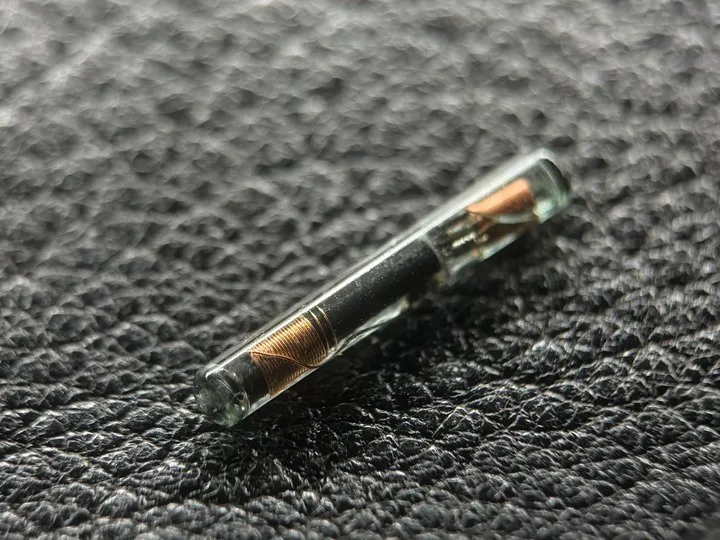
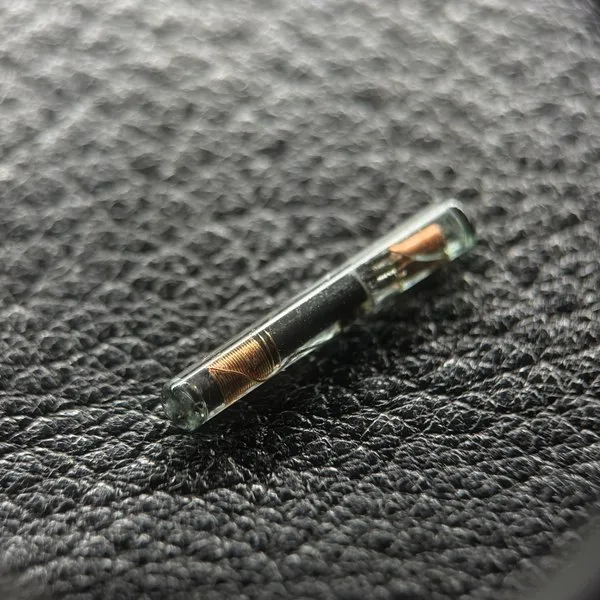
13.56MHz NFCと125kHz RFIDを1本に収めたデュアル周波数インプラント Dual frequency implant: 13.56 MHz NFC and 125 kHz RFID in one 2.1 x 15 mm body.
2.1×15mmNXP NTAG216
NExTは
NExTは、
13.56MHz側の
できない
読み取り距離は
The NExT is a cylindrical passive transponder sealed in biocompatible glass, 2.1 mm by 15 mm. Inside are two independent ICs on two different frequencies: an NXP NTAG216 at 13.56 MHz and a T5577 at 125 kHz. Neither has a battery or a power source of its own. Both draw the power they need from the magnetic field the reader generates.
The 13.56 MHz side is ISO14443A and NFC Type 2 compliant, so ordinary NFC phones and USB contactless readers can read it. It carries a 7 byte UID and 886 bytes of user read and write memory, which you can fill with a URL, a contact record or other NDEF data and change whenever you like. The 125 kHz side is an emulator. It ships preprogrammed in EM41xx mode with a 40 bit ID, and it can be reprogrammed to behave like EM4200, HID 1326 ProxCard II, HID 1346 ProxCard III, Indala and other common low frequency formats, which is what lets it work with a wide range of 125 kHz access controllers.
The limits are worth knowing before you buy. The 13.56 MHz UID is fixed at manufacture and cannot be changed; only the 125 kHz side can be rewritten with another ID. There is no secure element and no cryptographic function, so whatever you write into the NFC memory can be read by any reader brought near it. It is not suitable for secure identification, and it does not make payments.
Read range is short. A cylindrical antenna this size does not couple with a reader the way a flat card or label does, so most readers have a narrow spot where the read works and you have to find it once and then use it. The best orientation is with the length of the implant crossing the reader coil rather than lying along it. Read performance settles roughly 2 to 4 weeks after installation.
- 外形寸法Dimensions
- 2.1 mm x 15 mm
- 封止材Housing
- 生体適合ガラス (bioglass)
- NFC側ICNFC IC
- NXP NTAG216
- NFC規格NFC standards
- ISO14443A / NFC Type 2 (13.56 MHz)
- UIDUID
- 7 bytes
- ユーザーメモリUser memory
- 886 bytes
- データ保持Data retention
- 10 years / 100,000 writes per block
- 低周波側ICLF IC
- T5577 (125 kHz)
- 低周波側の
出荷時設定 LF factory mode - EM41xx, 40 bit ID
- 電源Power
- パッシブ (passive, no battery)
チップの
 VivoKey Spark 2VivoKey Spark 2
AES-128で
VivoKey Spark 2VivoKey Spark 2
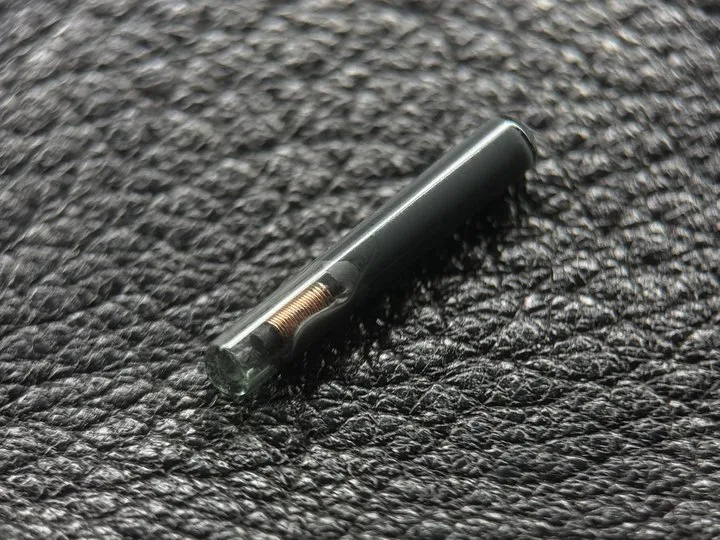
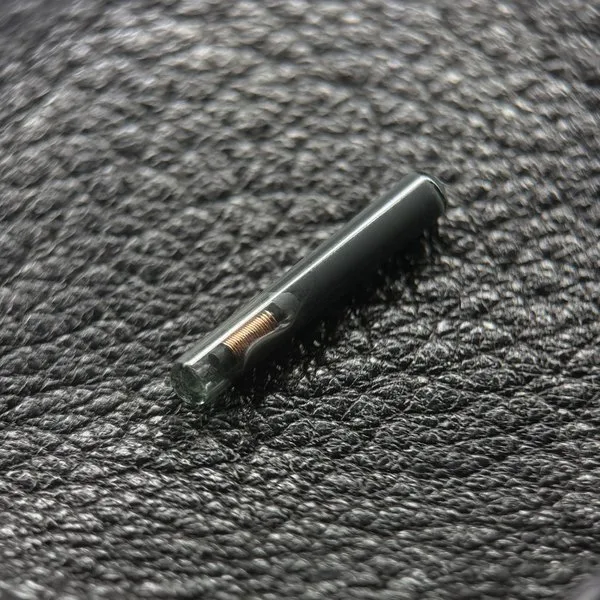
AES-128で本人確認を行う2.1×14mmの暗号NFCインプラント Cryptographic NFC identity implant, 2.1 x 14 mm, using AES-128 challenge and response.
2.1×14mm
Spark 2は
VivoKey Spark 2は、
実際の
Spark 2は
読み取り性能が
The VivoKey Spark 2 is a 13.56 MHz transponder sealed in biocompatible glass, 2.1 mm by 14 mm. It is ISO14443A and NFC Type 4 compliant, so NFC phones and ISO14443A USB readers can read it. Where an ordinary NFC tag simply hands over a fixed number that anyone can copy, the Spark 2 answers a challenge with an AES-128 calculation. That is the difference the product is built around: a reader can establish that this particular Spark 2 is present, rather than that something presented its ID.
In use, the Spark 2 works together with the VivoKey service and a VivoKey account. With Spark Actions configured, a phone that scans it can open a URL, place a call, or start an SMS or an email. What it does is set in the account rather than stored on the implant, so you can change it at any time. Access control systems that enrol a credential by its ISO14443A UID can in some cases enrol a Spark 2 as a key.
The Spark 2 is built for cryptographic identity and nothing else. It has no general purpose NDEF storage, so you cannot write your own files, text or URLs onto the implant itself. It does not make payments. It does not run applets and it is not the Tesla keycard product: that is the Apex, a different device.
Read performance settles roughly 2 to 4 weeks after installation. As with every small cylindrical transponder, each reader has a narrow spot where the read works reliably, and it is worth finding that spot once on the readers you use every day.
- 外形寸法Dimensions
- 2.1 mm x 14 mm
- 封止材Housing
- 生体適合ガラス (bioglass)
- 対応規格Standards
- ISO14443A / NFC Type 4 (13.56 MHz)
- 暗号方式Cryptography
- AES-128 (FIPS 197, CMAC per NIST SP 800-38B)
- NDEFユーザー領域NDEF user memory
- なし (none)
- 決済Payment
- 非対応 (not supported)
- 滅菌方法Sterilization
- 低温ガスプラズマ滅菌 (low-temperature gas plasma)
- 電源Power
- パッシブ (passive, no battery)
 xNTxNT
2.1×12mmの
xNTxNT
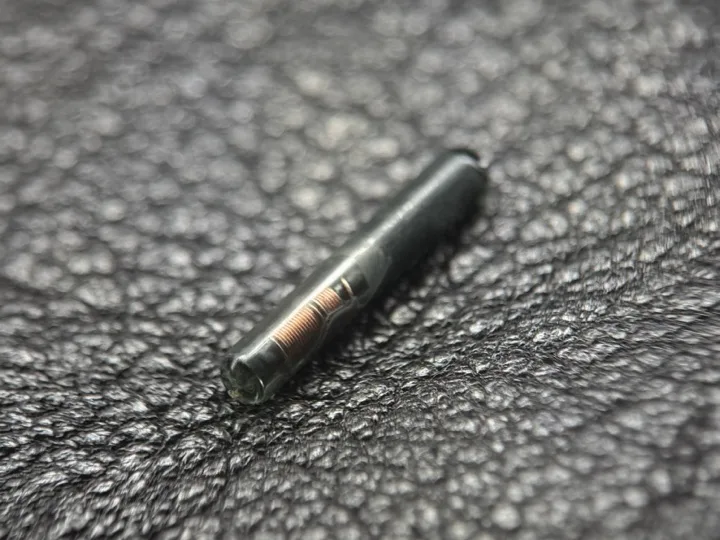
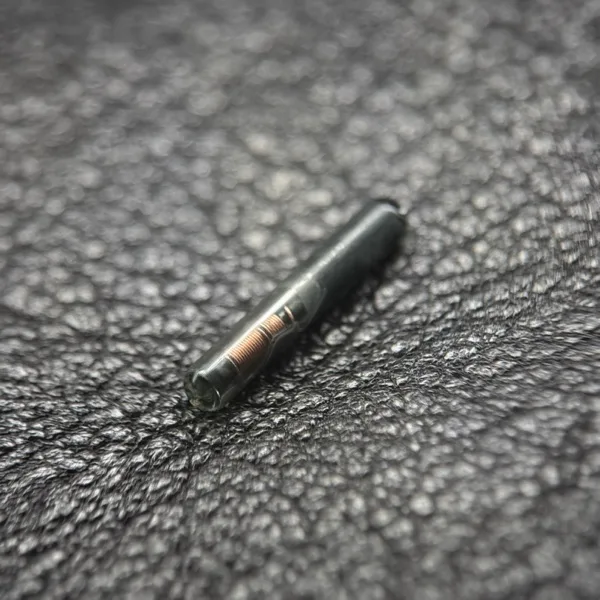
2.1×12mmのガラス製NFCインプラント。886バイトを自由に書き換えられます。 A 2.1 x 12 mm bioglass NFC implant with 886 bytes you write and rewrite yourself.
2.1×12mmNXP NTAG216
xNTを
xNTは、
読み取りは
出荷時点で、
できない
The xNT is a passive NFC transponder sealed in a cylinder of biocompatible bioglass, 2.1 x 12 mm. Inside is an NXP NTAG216 (13.56 MHz, ISO14443A and NFC Type 2) with a fixed 7 byte UID and 886 bytes of user memory that you read and write yourself. It carries no battery and draws power from the reader's field only while a reader is held to it.
It is read by NFC smartphones and by ISO14443A readers. Write a URL, contact details or arbitrary binary data with an ordinary NFC app, and an NFC phone that scans it reads it back. It also works with access systems that register the NTAG UID, but a UID can be read and copied, so do not make it your only key. The memory is rated for 100,000 writes per block and ten years of data retention.
It leaves the factory with the lock bits disabled and the configuration bytes password protected. That is deliberate: many NFC apps offer a lock or protect button that would otherwise turn an implant permanently read only, and the configuration bytes sit where a careless write can overrun them. The user memory itself arrives fully writable.
What it cannot do is equally clear. The UID is fixed, so no other credential's ID can be copied onto it. There is no secure element, so it is not for payment and is not a high assurance credential on its own. Anything written to it can be read by any NFC reader held close, so do not write anything you would not want a stranger to see. And because the antenna is a small cylinder rather than a flat card coil, the read range is short: every phone has a sweet spot that has to be found and used each time.
- サイズSize
- 2.1 × 12 mm
- 搭載ICIC
- NXP NTAG216
- 通信Interface
- 13.56 MHz / ISO14443A / NFC Type 2
- 筐体Housing
- 生体適合ガラス / Bioglass
- ユーザーメモリUser memory
- 886 B
- UIDUID
- 7 B
- 書き換え耐性Write endurance
- 100,000
- データ保持Data retention
- 10年 / 10 years
- 性能が
安定するまで Peak performance - 2〜4週間 / 2 to 4 weeks
チップの
xMagicxMagic
13.56MHzと125kHz、両方のIDを書き換えられる複製用インプラント Dual frequency cloning implant: writable MIFARE Classic 1k emulator plus T5577.
Magic MIFARE Classic 1k emulator
xMagicは
xMagicは、
HF側は
できない
読み取り距離に
The xMagic holds two separate emulator ICs in one bioglass cylinder of 3 mm by 15 mm: a 13.56 MHz "magic" MIFARE Classic 1k emulator and a 125 kHz T5577. On an ordinary card the block that carries the ID is locked at manufacture. On both sides of the xMagic it is writable, so the device can be programmed to present the ID and data of many existing access badges, key fobs and cards.
The HF side emulates a MIFARE MF1ICS50 1k with a 4 byte ID and a writable sector 0, rated for 10 year data retention and 100,000 writes per memory block. The LF side emulates EM41xx, EM4200, HID Prox, Indala and many other 125 kHz protocols, and ships configured in EM41xx mode with a 40 bit unique ID. Programming is done with an external reader and programmer, normally a Proxmark3. Two versions are offered: gen1a unlocks every sector with a backdoor command that cannot be sent from an Android phone, so a Proxmark3 is required, and some readers detect and reject gen1a devices. gen2 uses ordinary access bits and keys, can be programmed in the field with an Android app, and is harder for a reader to detect, but a sector can be locked out if it is programmed incorrectly.
What the xMagic does not do: it has no NDEF support, so it cannot share data with a smartphone or trigger actions on an NFC device. It has no secure element and no cryptography, and it cannot be used for payment. Cards that use a 7 byte UID, such as MIFARE Plus and MIFARE Classic 1k EV1, cannot be copied completely, because the emulator supports only a 4 byte ID.
Read range: the coil inside an x-series device is a small cylinder, and most readers and phones have flat rectangular antennas shaped for cards and labels, so the two do not couple as well. Expect to find a sweet spot on each reader rather than the range you get from a card.
- 周波数Frequencies
- 13.56 MHz + 125 kHz
- HF側HF chip
- Magic MIFARE Classic 1k emulator (gen1a / gen2)
- LF側LF chip
- T5577
- 寸法Dimensions
- 3 mm × 15 mm
- 外装Housing
- 生体適合ガラス (bioglass) + epoxy
- データ保持Data retention
- 10 years / 100,000 writes
- 性能が
安定するまで Peak performance - 2〜4週間 (2 to 4 weeks)
- 決済Payment
- 非対応 (not supported)
チップの
 xDFxDF
MIFARE DESFire搭載インプラント。
xDFxDF
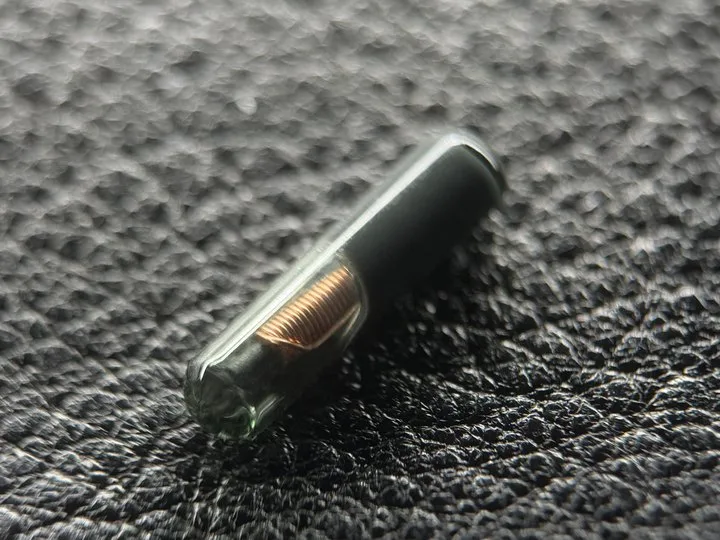
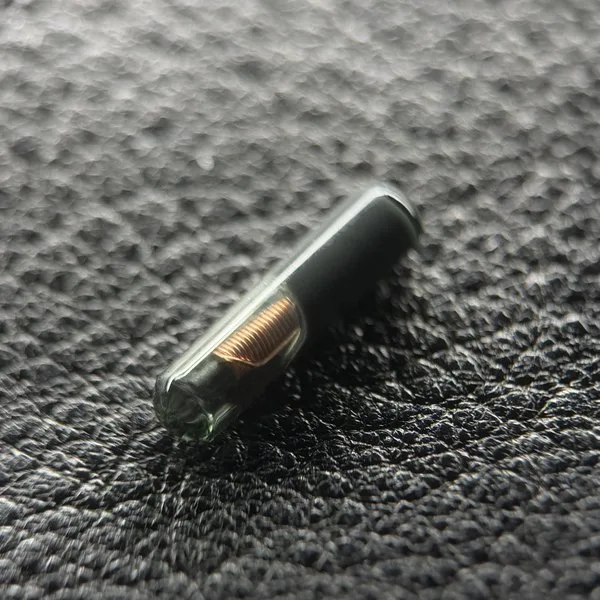
MIFARE DESFire搭載インプラント。8kBメモリとDES/3DES/AESに対応 MIFARE DESFire implant: DESFire access control, DES, 3DES and AES, 8 kB of memory.
MIFARE DESFire
お届けする
xDFは、
ご注文前に
できない
The xDF is our DESFire option: an x-series implant carrying a MIFARE DESFire IC and working at 13.56 MHz. It suits access control systems built on DESFire rather than on a bare UID, supports DES, 3DES and AES on the chipset itself, and offers about 8 kB of memory for data the customer chooses to store.
One thing to settle before ordering. DESFire exists in several generations (EV1, EV2, EV3), and the generation supplied is whichever one can be sourced at the time. If your access control system requires a specific generation, please ask us to confirm what is in stock before you order.
What it does not do: payment is not supported, the UID cannot be changed and other card types cannot be emulated, and there is no illumination and no sensor.
- 周波数Frequency
- 13.56 MHz
- 搭載ICChipset
- MIFARE DESFire (EV generation varies)
- 暗号Cryptography
- DES / 3DES / AES
- ユーザーメモリUser memory
- 8 kB
- 性能が
安定するまで Peak performance - 2〜4週間 (2 to 4 weeks)
- 決済Payment
- 非対応 (not supported)
チップの
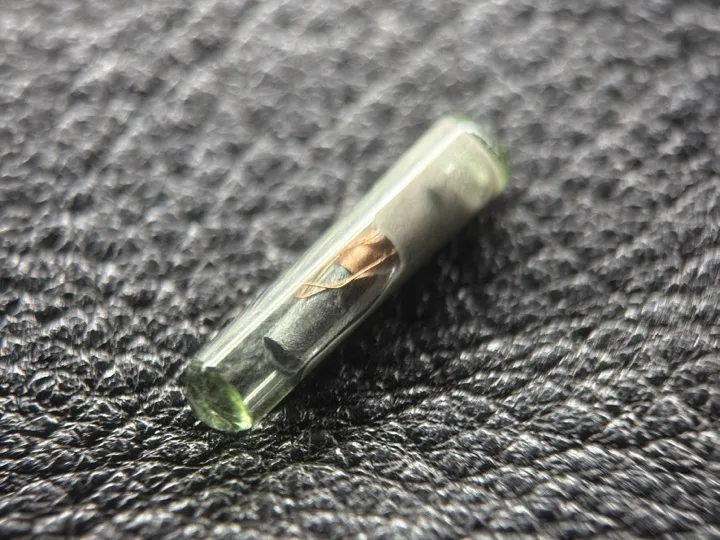 xM1xM1
セクター0を
xM1xM1
セクター0を書き換えられるMIFARE Classic 1kエミュレータ MIFARE Classic 1k emulator with a writable sector 0, sealed in bioglass
3×13mm
xM1は、
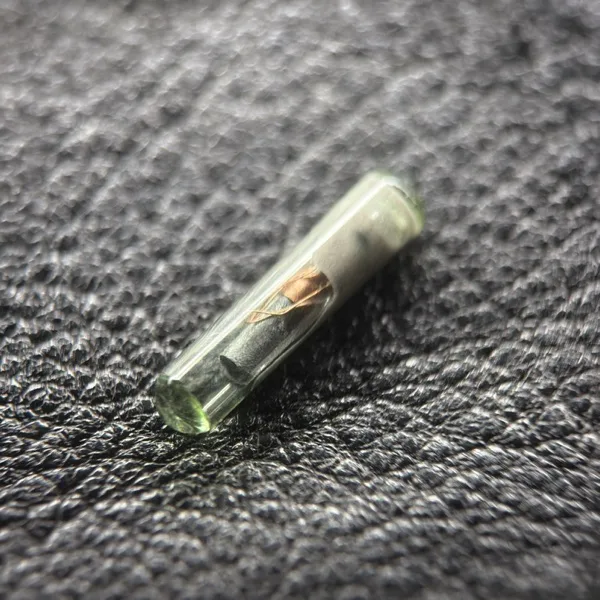
xM1は、
バリエーションは
対応する
xM1は
The xM1 is a 13.56 MHz MIFARE Classic 1k emulator in a bioglass cylinder, 3 mm across and 13 mm long, sealed with a non-toxic medical epoxy. What separates it from an ordinary MIFARE Classic transponder is that sector 0, the manufacturer block that holds the 4 byte NUID, is writable. Every page of every sector can be overwritten, so the device can be set to present the ID and contents of a MIFARE Classic 1k badge, fob or card from a system you administer.
Two variants exist and they differ only in how sector 0 is opened for writing. The gen2 uses the normal MIFARE access bits and keys A and B, exactly as it does for any other sector, which means it can be programmed in the field from an Android phone running MIFARE Classic Tool, with no dedicated hardware. It is also much harder for a reader to detect as an emulator. The trade off is that a mistake in the access bit configuration can lock you out of a sector permanently. The gen1a instead accepts a special backdoor command that disables all keys and access control across every sector, so no sector can ever be locked out. That command cannot be sent from an Android app and needs a programmer such as a Proxmark3, and some readers actively look for gen1a behavior and reject it.
Only 4 byte IDs are supported. A source card must be a genuine 4 byte MIFARE Classic 1k; the newer 7 byte types such as MIFARE Classic 1k EV1 and MIFARE Plus 1k cannot have their full ID reproduced here.
The xM1 has no NDEF support, so it does not share data with NFC phones and does not trigger actions on them. It is 13.56 MHz only, with no 125 kHz side. It cannot be used for payments.
- 寸法Dimensions
- 3 mm diameter x 13 mm
- 封止材Encapsulation
- Bioglass + medical epoxy / 生体適合ガラス、医療用エポキシ
- 動作周波数Frequency
- 13.56 MHz
- 規格Standard
- ISO 14443A, MIFARE Classic 1k (MF1ICS50) emulation
- IDID
- 4 byte NUID, sector 0 writable
- バリエーションVariants
- gen1a / gen2
- データ保持Data retention
- 10 years / 10年, 100,000 writes per block
- 性能が
安定するまで Time to peak performance - 2 to 4 weeks / 2〜4週間
- MRIMRI
- MR conditional
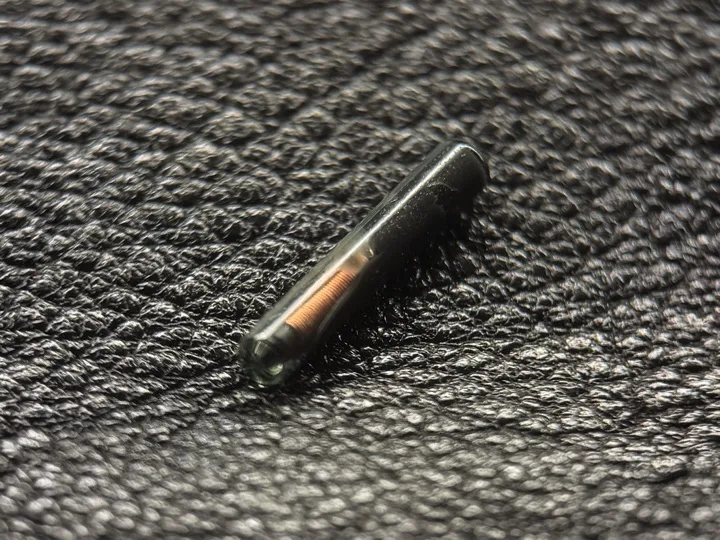 xSLXxSLX
ISO15693/NFC Type 5対応、
xSLXxSLX
ISO15693/NFC Type 5対応、320バイトのガラス製インプラント ISO15693 / NFC Type 5 glass implant, 2.1 mm x 12 mm, 320 bytes of user memory.
2.1×12mmNXP ICODE SLIX2
xSLXは、
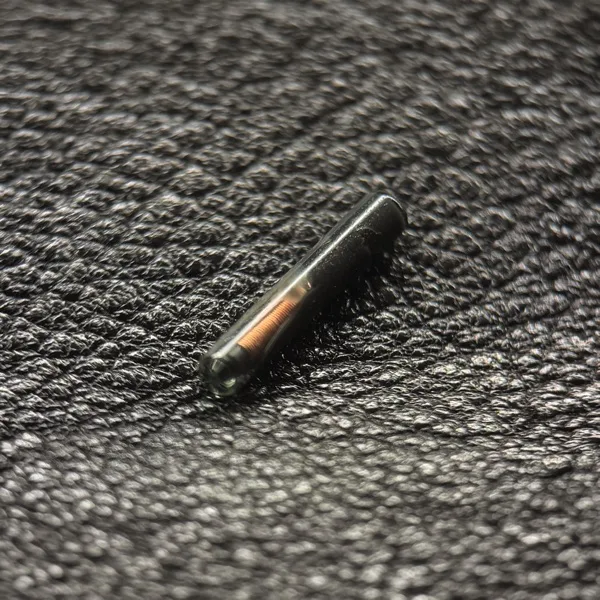
xSLXは、
8バイトの
UIDは
インストールは、
The xSLX is a passive 13.56 MHz transponder sealed in a cylindrical bioglass capsule measuring 2.1 mm by 12 mm. Inside is an NXP ICODE SLIX2, which follows ISO15693, the standard the NFC Forum lists as NFC Type 5. It has no battery and no power source of its own: it takes the energy it needs from the field the reader in front of it generates.
It carries an 8 byte fixed UID and 320 bytes of read and write memory. What goes into that memory is the customer's choice and stays under the customer's control. Data retention is rated at 50 years, with 100,000 writes per memory block. NFC capable smartphones can read and write it, and USB ISO15693 desktop readers, ISO15693 door locks, gun safes and padlocks will respond to the UID.
The UID is fixed at manufacture, so the ID of an existing card or key fob cannot be copied onto an xSLX. The system you intend to use has to be told this UID instead. There is no secure element and no cryptography, so it is not suitable for payment or for secure identification, and whatever is written to its memory can be read by any ISO15693 reader nearby. ISO15693 keyboard wedge readers are uncommon, which also makes it a poor choice for computer login.
VivoKey Japan requires installation by a physician, who is responsible for it, as its own safety and quality standard.
- 搭載ICChip
- NXP ICODE SLIX2
- 規格Standard
- ISO15693 / NFC Type 5, 13.56 MHz
- 寸法Dimensions
- 2.1 mm x 12 mm
- 筐体Housing
- 生体適合ガラス / Bioglass
- メモリMemory
- 320 bytes user memory, 8 byte UID
- データ保持Data retention
- 50 years, 100,000 writes per block
- 性能が
安定するまで Peak performance - 2-4 weeks
チップの
 NExT v2NExT v2
13.56MHzの
NExT v2NExT v2
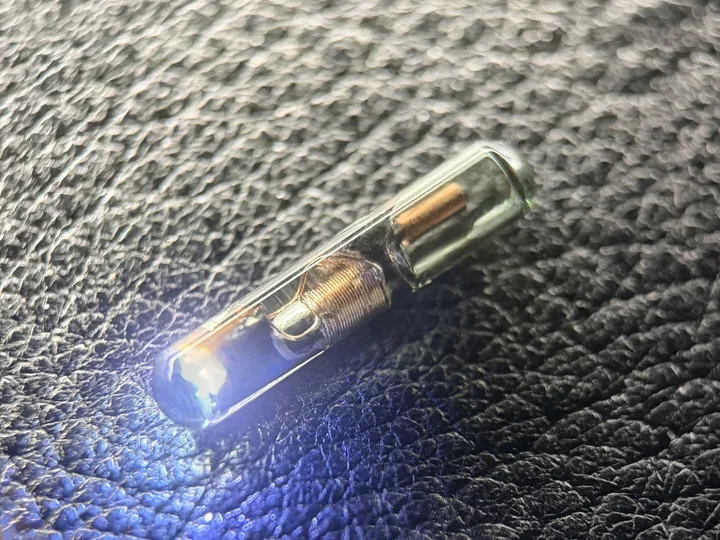
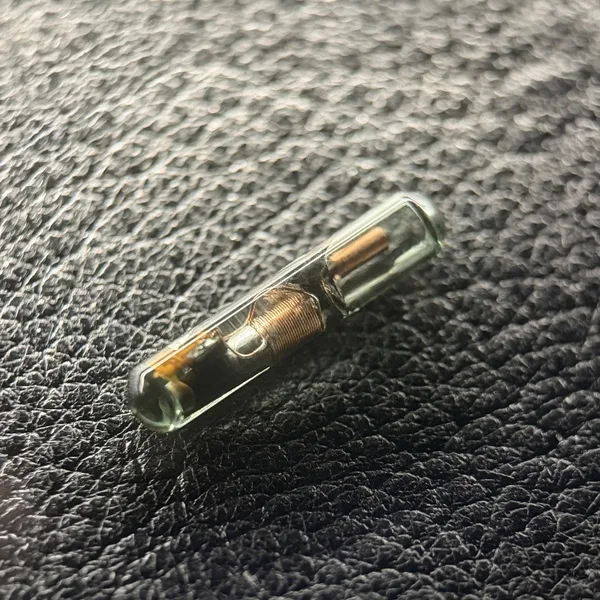
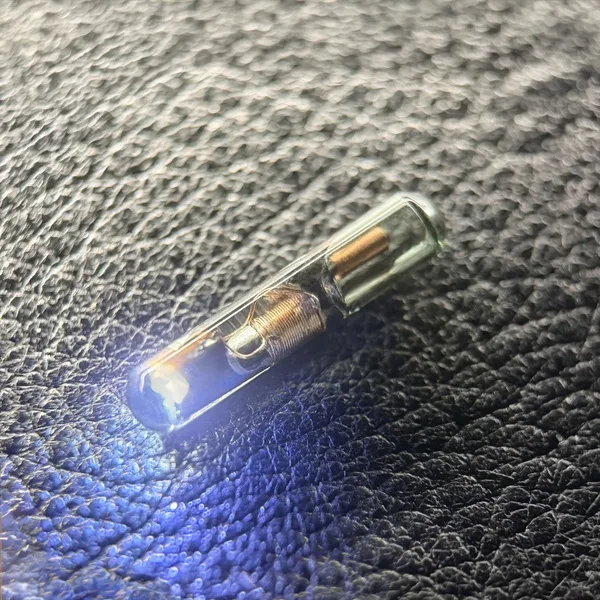
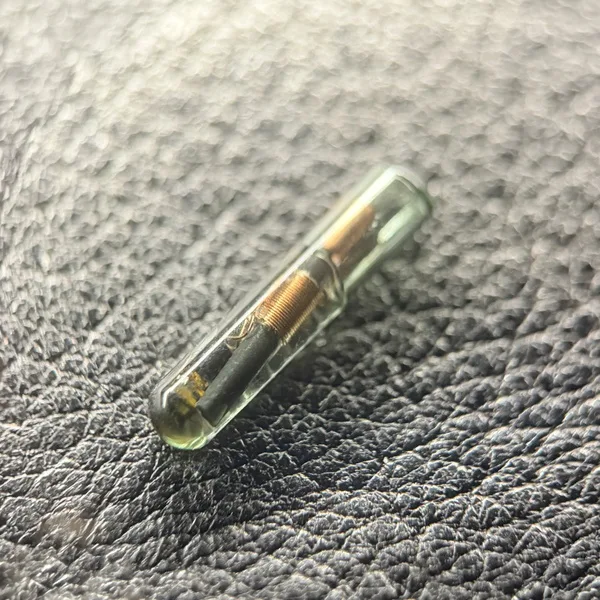
13.56MHzのNFCと125kHzのRFID、LEDを備えたデュアル周波数モデル Dual frequency glass implant: 13.56 MHz NFC and 125 kHz RFID, with an LED.
3.1×15mm
NExT v2は、
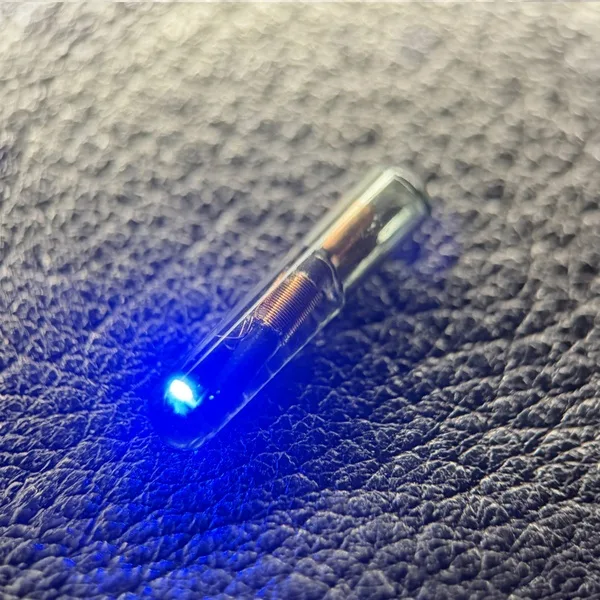
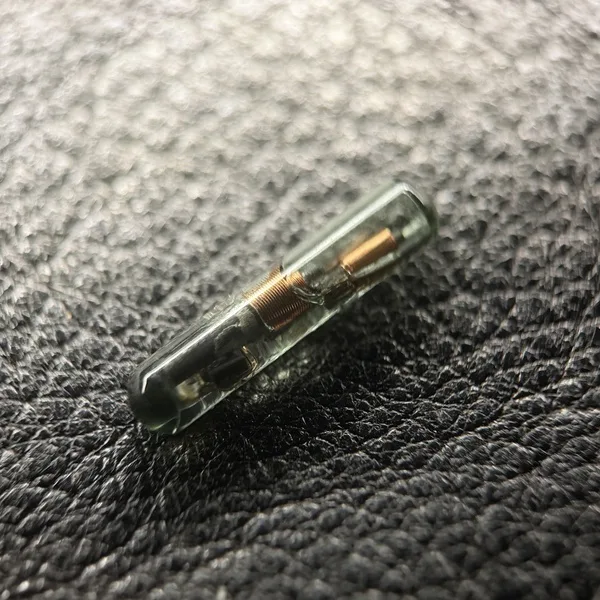
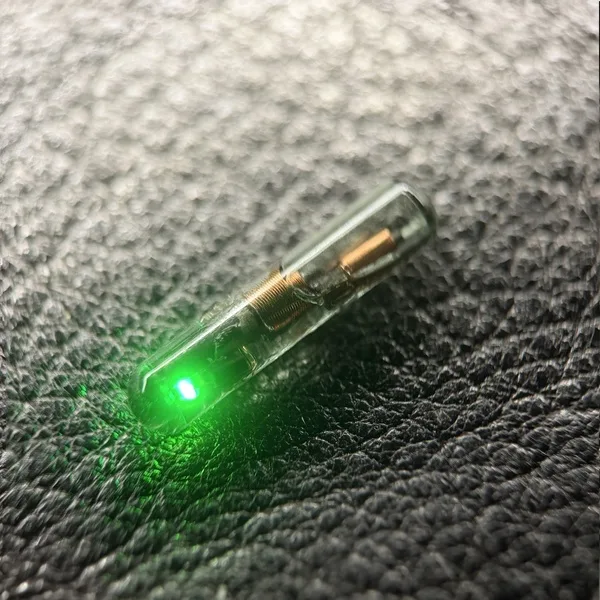
NExT v2は、
13.56MHz側は
125kHz側は
決済には
The NExT v2 puts two transponders in one cylindrical bioglass capsule of 3.1 mm by 15 mm: a 13.56 MHz NFC device and a 125 kHz RFID device. They work independently of each other, so a single product answers two families of reader that would otherwise need two separate credentials.
The 13.56 MHz side is an NXP NTAG I2C, ISO14443A and NFC Type 2, with a 7 byte fixed UID and 888 bytes of user writable memory: a URL, contact details, or arbitrary binary data, readable and writable from any NFC capable smartphone. An LED is wired to the energy harvesting pins of that same chip, so it lights inside a reader field without drawing power away from the NFC circuit. VivoKey Japan stocks the LED in green and blue, and white is available by special order. It has never been produced in red.
The 125 kHz side is an Atmel T5577, shipped pre-programmed with a 40 bit EM41xx ID. Unlike the NFC UID, this side can be rewritten. It emulates EM41xx, EM4200 and other common low frequency formats, so it can be set to the ID an existing 125 kHz reader already expects.
It cannot be used for payment. Neither side has a secure element or cryptography, so it is not suitable for secure identification, and anything written to the NFC memory can be read by any NFC reader nearby.
- 搭載ICChips
- NXP NTAG I2C + Atmel T5577
- 規格Standards
- 13.56 MHz ISO14443A / NFC Type 2, 125 kHz
- 寸法Dimensions
- 3.1 mm x 15 mm
- 筐体Housing
- 生体適合ガラス / Bioglass
- NFC側メモリNFC memory
- 888 bytes user memory, 7 byte UID
- NFC側データ保持NFC data retention
- 10 years, 100,000 writes per block
- 125kHz側125 kHz side
- T5577, pre-programmed EM41xx 40 bit ID
- LEDLED
- Green / Blue / White
- 性能が
安定するまで Peak performance - 2-4 weeks
チップの
 xSIIDxSIID
2.1×15mmの
xSIIDxSIID
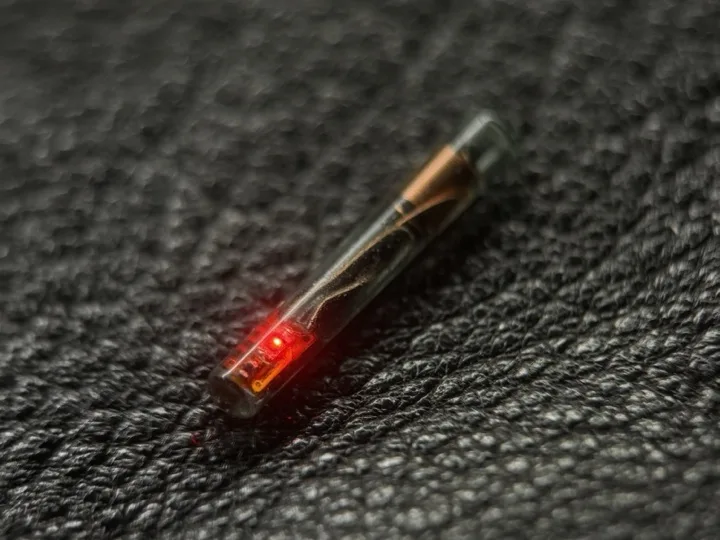
2.1×15mmの生体適合ガラス。書き込み可能なNFCと、リーダーの電力で光るLED。 Writable NFC implant in 2.1 x 15 mm bioglass, with an LED lit by the reader's field.
2.1×15mmNXP NTAG I2C Plus 2K
x-seriesは
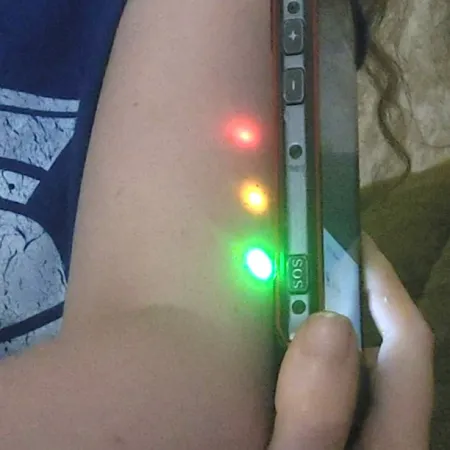
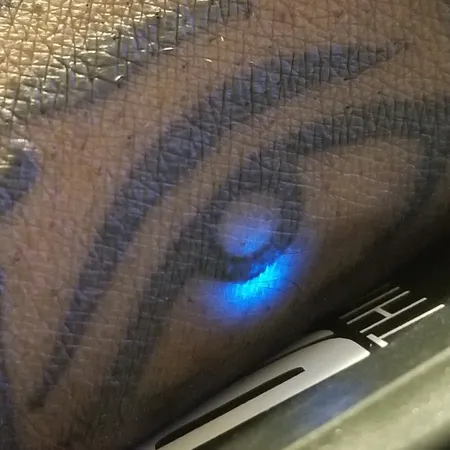
xSIIDは、
メモリは
セキュアエレメントではありません。
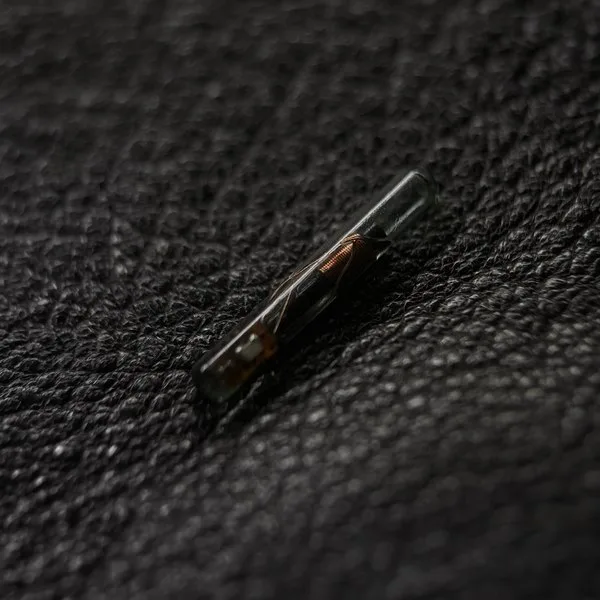
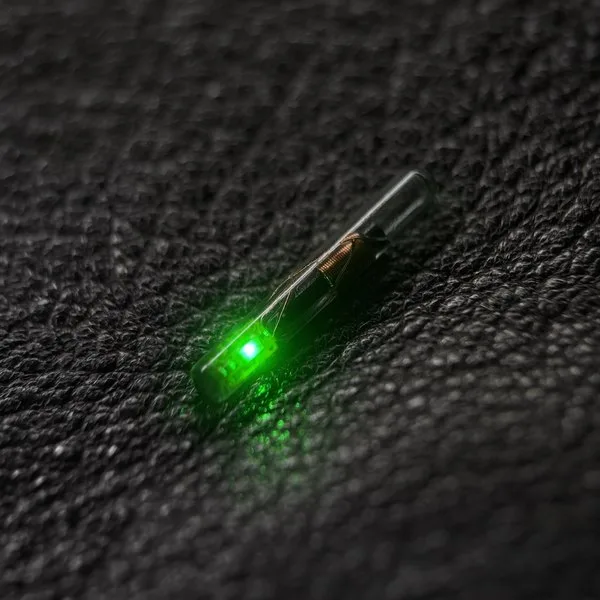
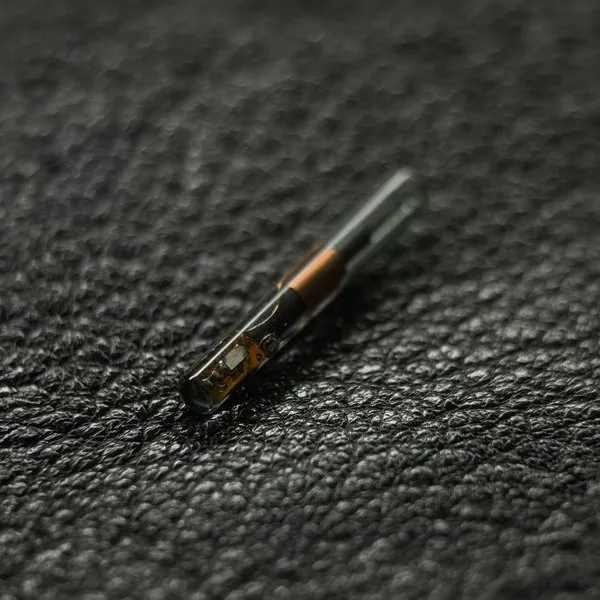
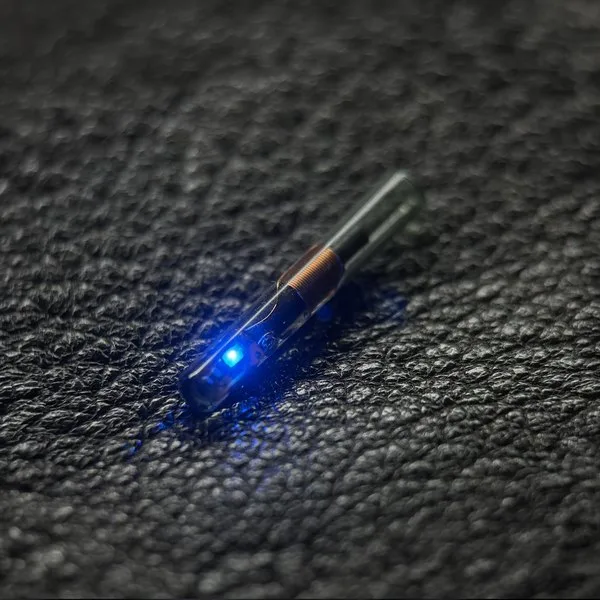
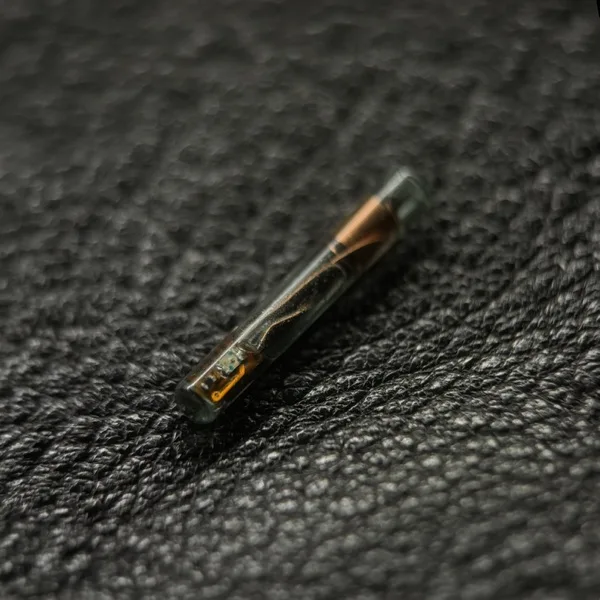
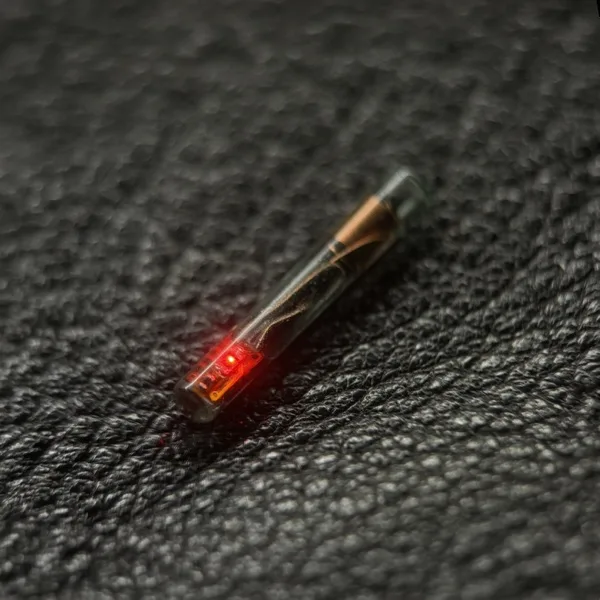
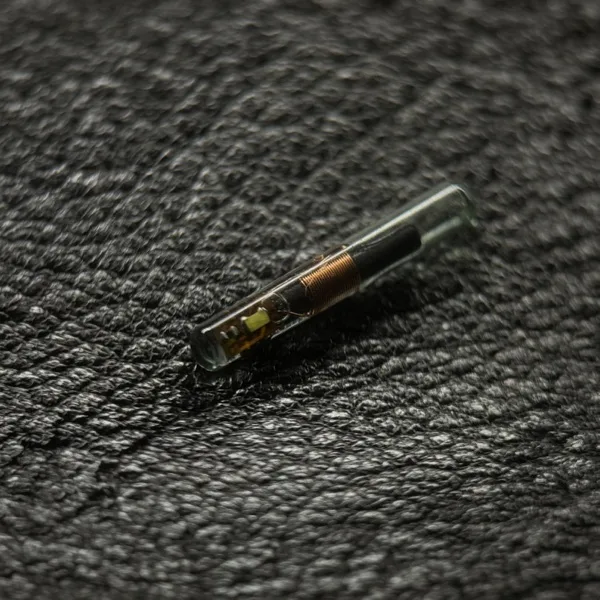
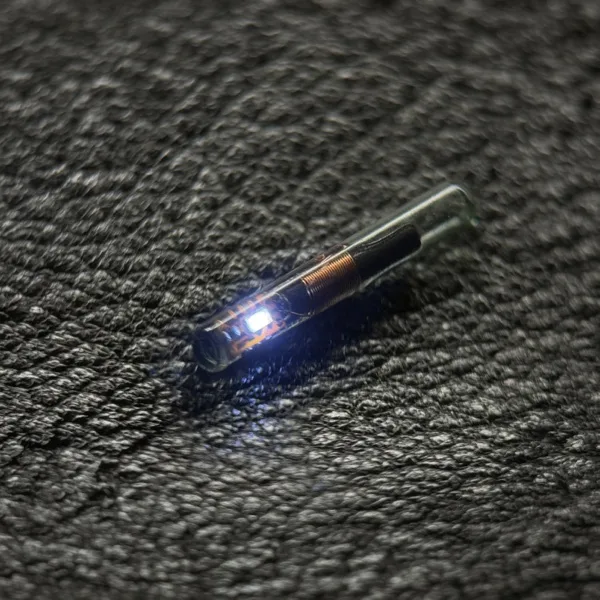
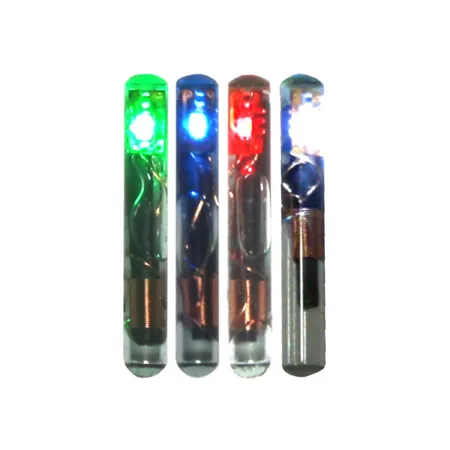
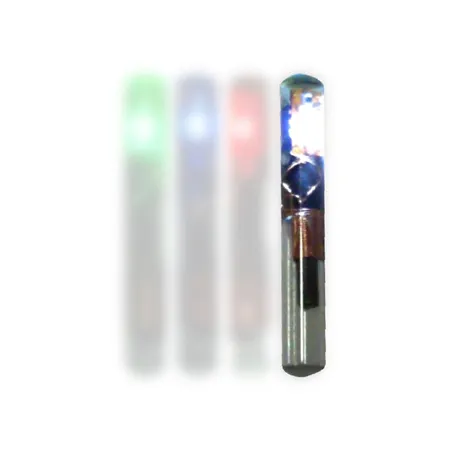
The xSIID is a passive 13.56 MHz NFC transponder sealed in a cylinder of biocompatible glass, 2.1 mm across and 15 mm long. Inside it is an NXP NTAG I2C Plus 2K chipset and an LED wired to the chipset's energy harvesting output, so the LED lights while a reader is powering the implant and is dark the rest of the time. VivoKey Japan stocks the red and the white LED.
The memory is yours to write and rewrite from a compatible smartphone: a URL, a contact card, the trigger for a phone automation. There are 1912 bytes of user memory in total, of which the first 868 or so are what current phone apps reach. It reads on ordinary NFC phones and readers, though the antenna inside an implant is small and cylindrical, so every reader has a spot and an angle where the two antennas couple well, and you learn where that is on the readers you use.
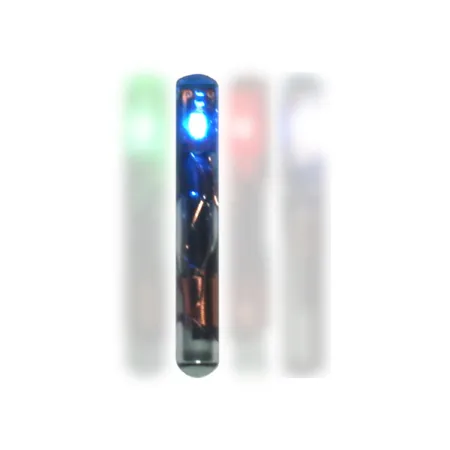
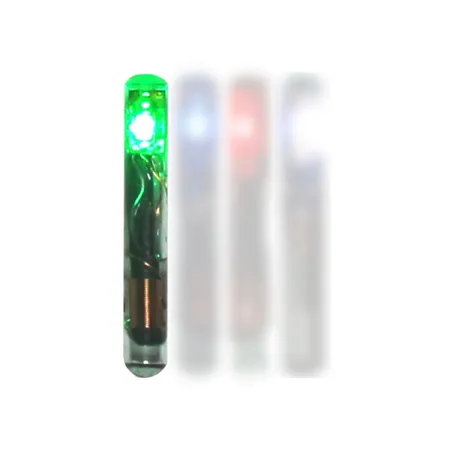
It is not a secure element. It holds no keys and performs no cryptography, so it is not a credential for payment or for identification that has to be trusted. VivoKey Japan does not offer payment-capable implants. Anything written to it can be read by any NFC reader held close to it, so it is not the place for information you would not show a stranger. The blue and green LED versions are sold out and discontinued worldwide.
- サイズSize
- 2.1 × 15 mm
- 無線規格Radio standard
- 13.56 MHz, NFC Forum Type 2, ISO 14443A
- 搭載ICCore IC
- NXP NTAG I2C Plus 2K
- ユーザーメモリUser memory
- 1912 bytes (約868バイトがスマートフォンから到達可能 / about 868 reachable from a phone)
- LEDLED
- Red / White
- データ保持Data retention
- 10 years / 10年
- ブロックあたり
書き換え回数 Write cycles per block - 100,000
- 性能が
安定するまで Peak performance - 2-4 weeks / 2〜4週間
- MRIMRI
- MR Conditional (up to 3 T)
チップの
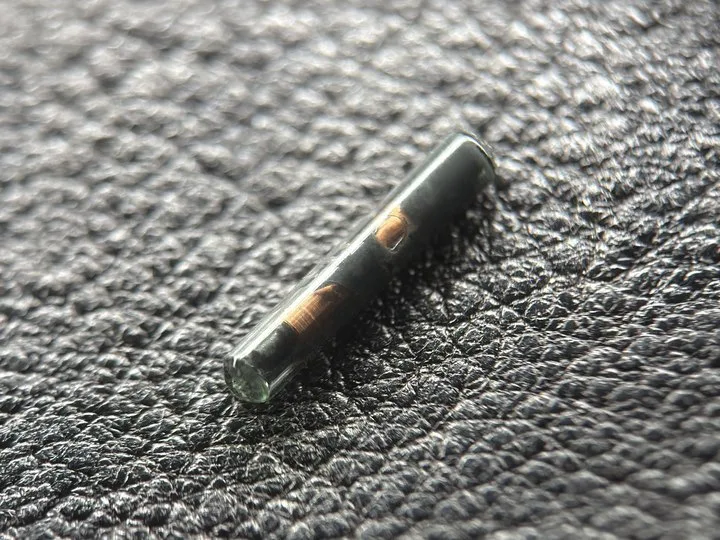 xEMxEM
2.1×12mmの
xEMxEM
2.1×12mmの生体適合ガラス。125kHz帯の旧式カードを再現するT5577。 125 kHz T5577 implant in 2.1 x 12 mm bioglass that can present itself as legacy LF cards.
2.1×12mmAtmel T5577
この
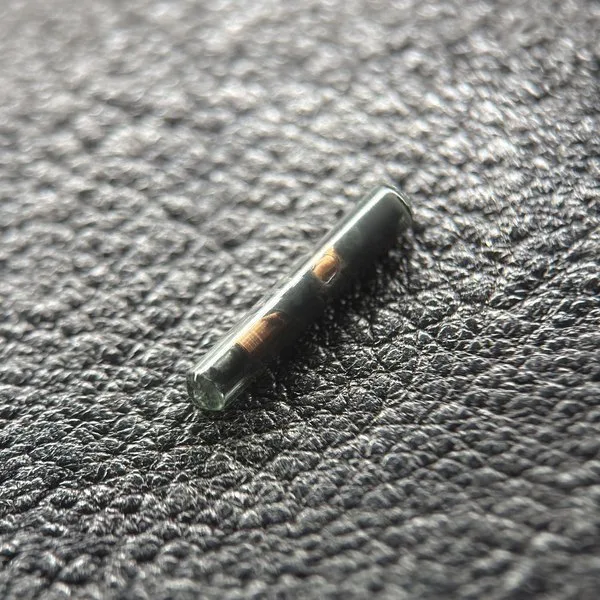
xEMは、
書き込みは、
125kHzは
The xEM is a passive 125 kHz transponder sealed in biocompatible glass, 2.1 mm across and 12 mm long. The part inside is an Atmel T5577, a writable low frequency emulator: rather than carrying one fixed identity, it can be programmed to behave like a number of common low frequency card and fob types, among them EM41xx, EM4200, HID ProxCard II and III, Indala, Pyramid, Viking, AMV and Presco. It ships preprogrammed in EM41xx mode with a 40 bit unique ID.
Writing it takes a 125 kHz writer, a Proxmark3 or similar, held against the implant. That is what makes the xEM a practical answer for an existing low frequency door or gate: the credential the reader already accepts can be written onto the implant, with no change at the reader. It also works with a wide range of inexpensive low frequency readers and standalone access controllers.
125 kHz is not NFC. No smartphone reads this implant, it shares no data with phones, it triggers nothing on a phone, and it is not used for payment. It is also not a security product: credentials of this class carry no encryption and identify themselves to anything that asks. Which reader accepts which emulated type has to be checked case by case, so tell us the reader model and we will answer what we can.
- サイズSize
- 2.1 × 12 mm
- 無線規格Radio standard
- 125 kHz
- 搭載ICCore IC
- Atmel T5577
- 出荷時設定Factory setting
- EM41xx, 40 bit ID
- 再現できる
方式 Emulates - EM41xx, EM4200, HID ProxCard II / III, Indala, Pyramid, Viking, AMV, Presco
- 書き込み機材Writing tool
- Proxmark3 (125 kHz)
- 性能が
安定するまで Peak performance - 2-4 weeks / 2〜4週間
- MRIMRI
- MR Conditional (up to 3 T)
チップの
 xHTxHT
2.1×12mmの
xHTxHT
2.1×12mmの生体適合ガラス。ISO 14223対応のHITAG S2048。 125 kHz HITAG S2048 implant in 2.1 x 12 mm bioglass, for ISO 14223 access systems.
2.1×12mmNXP HITAG S2048
本製品の
xHTは、
用途は
はっきり申し上げて
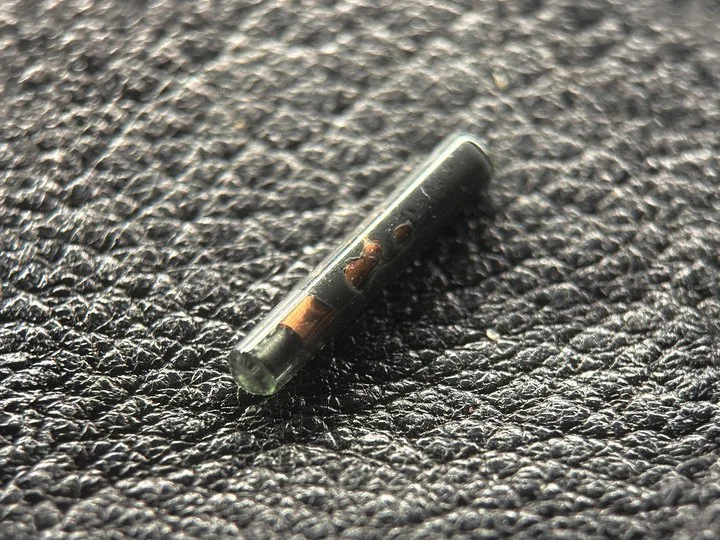
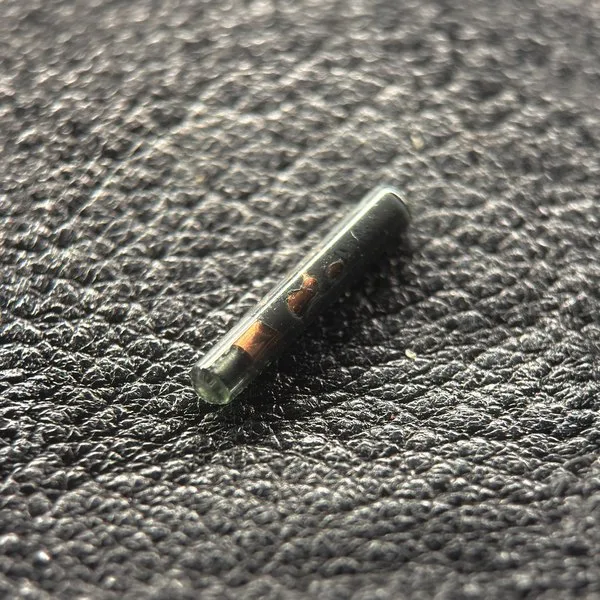
The xHT is a passive 125 kHz transponder sealed in biocompatible glass, 2.1 mm across and 12 mm long. The part inside is a HITAG S2048, compliant with ISO 14223 and also with ISO 11784 and ISO 11785 for animal identification and ISO 18000-2 for low frequency asset management. It carries 2048 bits of user read and write memory.
It exists for a narrow reason: some installed systems speak HITAG S and nothing else, and this is the implant that answers them. Unlike most low frequency parts, it supports a challenge and response exchange based on a 48 bit secret key, so the reader can ask it to prove itself rather than simply accepting the number it announces.
Two limits are worth stating plainly. First, 125 kHz is not NFC: no smartphone reads this implant, it shares no data with phones, and it is not used for payment. Second, the authentication scheme is the manufacturer's own and published attacks against it exist, so read it as better than an open low frequency card rather than as a security product. Its identity is fixed and it does not emulate other tag types; for that, the xEM is the part.
- サイズSize
- 2.1 × 12 mm
- 無線規格Radio standard
- 125 kHz, ISO 14223
- 搭載ICCore IC
- NXP HITAG S2048
- ユーザーメモリUser memory
- 2048 bits
- 認証Authentication
- 48 bit secret key, challenge and response
- その
他準拠規格 Also compliant with - ISO 11784 / 11785, ISO 18000-2
- 性能が
安定するまで Peak performance - 2-4 weeks / 2〜4週間
- MRIMRI
- MR Conditional (up to 3 T)
チップの
flex系統flex8
薄く
 Apex FlexApex Flex
アプレットを
Apex FlexApex Flex
アプレットを選んで書き込めるJava Cardセキュリティキー。アンテナ形状は3種類 Implantable Java Card security key in three antenna formats, applets deployed via Fidesmo.
8×28mm
Apex Flexは
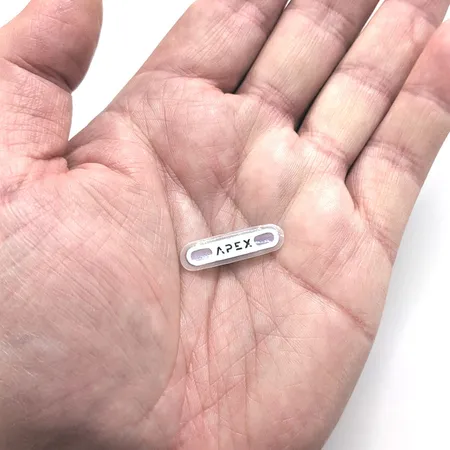
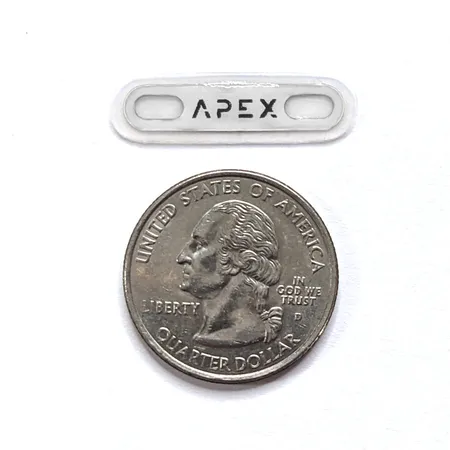
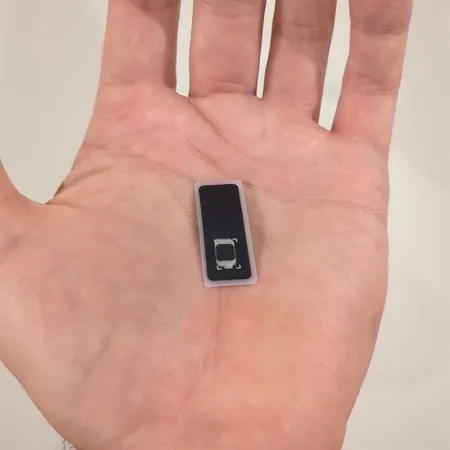
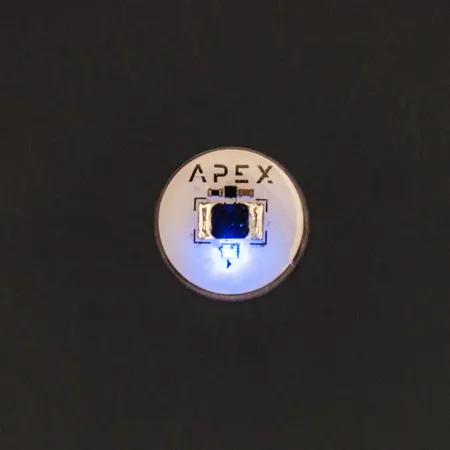
Apex Flexは、
利用できる
置ける
本体の
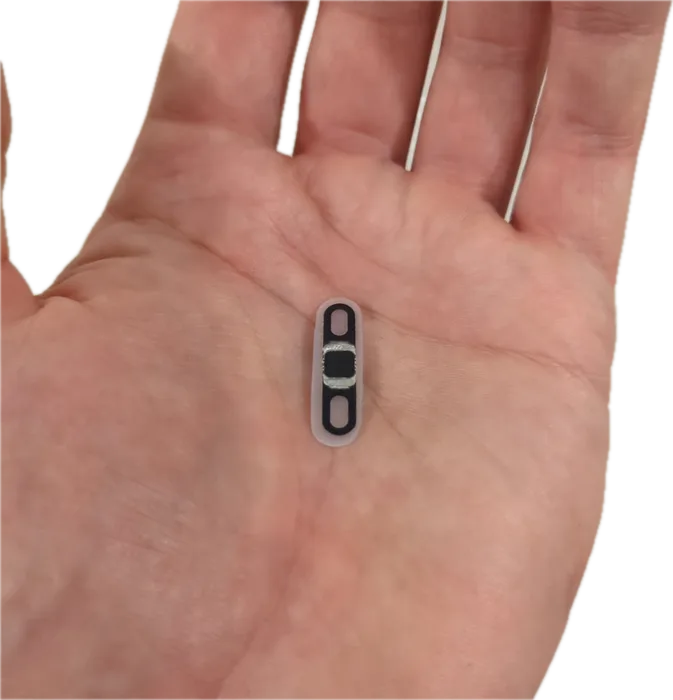
The Apex Flex is a Java Card security key in an implantable format. It runs JCOP 4 and Java Card 3.0.5, carries 83,872 bytes of application EEPROM, and supports RSA up to 4096 bit, ECC up to 521 bit, AES-128, AES-192, AES-256 and 3DES. The platform holds Common Criteria EAL 6+ certification. What an Apex actually does is not fixed at the factory: you choose applets on the Fidesmo platform and deploy them to it, and you can change them later.
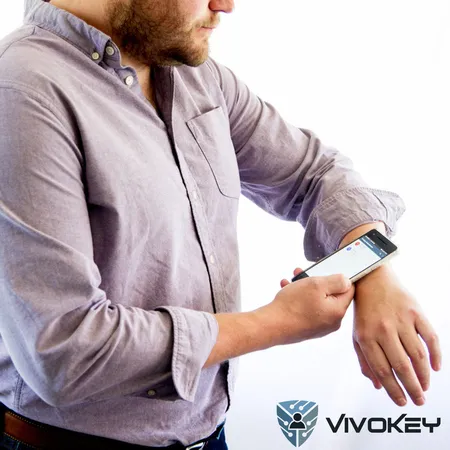
Available applets include a one time password authenticator for two factor login, U2F and FIDO2 security key applets, PGP, and NFC Share for handing over 1 kB to 32 kB of data with a scan. It can also be registered as a keycard for the Tesla Model 3 and Model Y, and for the Model S and Model X from 2021 onward. Everything is managed from a phone with the VivoKey Apex Manager app and the Fidesmo app.
There are three antenna formats and they install very differently. It is the easiest to place and gives the widest choice of location, and it has the shortest read range of the three. Module is 14 mm by 35 mm with a longer read range, and it needs an advanced installation. Spectrum is a disc, 22 mm across and 1.9 mm thick, with an RGB LED, and it also needs an advanced installation.
The body is a biopolymer whose raw material is tested to ISO 10993 and USP Class VI. Each unit is gas plasma sterilized in a sealed Tyvek pouch carrying a lot label, with a second polymer pouch around it. Read performance settles roughly 4 to 8 weeks after installation.
- プラットフォームPlatform
- JCOP 4 / Java Card 3.0.5
- アプリケーション用EEPROMApplication EEPROM
- 83,872 bytes
- 暗号方式Cryptography
- RSA (to 4096) / ECC (to 521) / AES-128, 192, 256 / 3DES
- 認証Certification
- Common Criteria EAL 6+
- 対応規格Standards
- ISO14443A / NFC (13.56 MHz)
- NFC Share容量NFC Share capacity
- 1 kB to 32 kB
- アンテナ: NarrowAntenna: Narrow
- 8 mm x 28 mm
- アンテナ: ModuleAntenna: Module
- 14 mm x 35 mm
- アンテナ: SpectrumAntenna: Spectrum
- 22 mm x 1.9 mm (RGB LED)
- 素材Material
- バイオポリマー (ISO 10993 / USP Class VI)
- 滅菌方法Sterilization
- ガスプラズマ滅菌 (gas plasma)
- 決済Payment
- 非対応 (not supported)
チップの
 flexNTflexNT
xNTと
flexNTflexNT
xNTと同じNTAG216を、9×22mmの薄型で。読み取り距離が大きく伸びます。 The same NTAG216 as the xNT, in a flat 9 x 22 mm package with far better read range.
9×22mmNXP NTAG216
flex製品は
flexNTは、
機能
制約も
インストールの
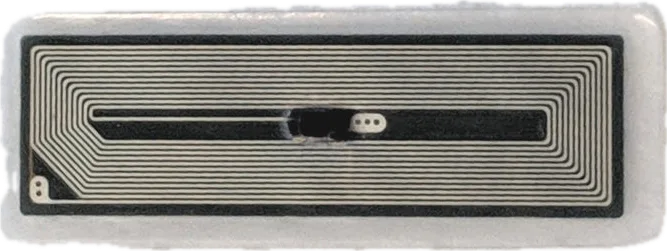
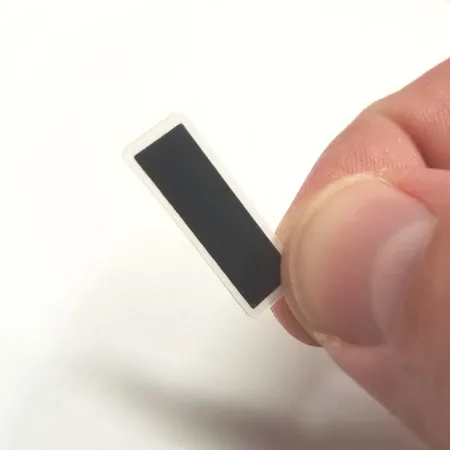
The flexNT carries the same NXP NTAG216 as the xNT, in a flat flexible biopolymer package of 9 x 22 x 0.4 mm. The difference is the antenna. A wide flat coil couples far better with the flat coils inside phones and reader panels than a small glass cylinder can, so read range and consistency are in a different class.
Functionally it is the same transponder: 13.56 MHz, ISO14443A and NFC Type 2, a fixed 7 byte UID, and 886 bytes of user memory you write yourself. Store a URL, a vCard or arbitrary data and share it with any NFC phone, trigger automations on a phone that scans it, or use the UID as a credential in an access control system that reads NTAG UIDs. Lock bits are disabled and the configuration bytes are password protected at the factory, so a stray lock button in an NFC app cannot make it read only.
The limits are the NTAG's limits. The UID is fixed and cannot be set to match another credential. There is no secure element, so no payment and no high assurance identity. Anything written to it is readable by any reader held close.
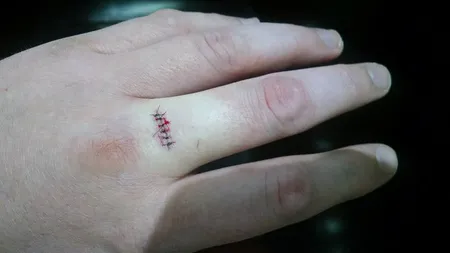
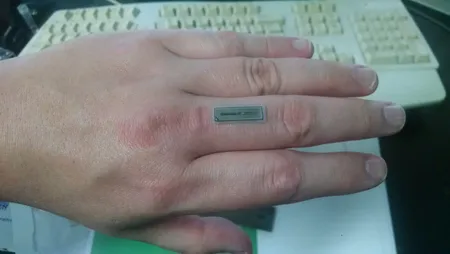
A flex is placed differently from a glass implant.
- サイズSize
- 9 × 22 × 0.4 mm
- 搭載ICIC
- NXP NTAG216
- 通信Interface
- 13.56 MHz / ISO14443A / NFC Type 2
- 筐体Housing
- バイオポリマー / Biopolymer
- ユーザーメモリUser memory
- 886 B
- UIDUID
- 7 B
- 性能が
安定するまで Peak performance - 4〜8週間 / 4 to 8 weeks
チップの
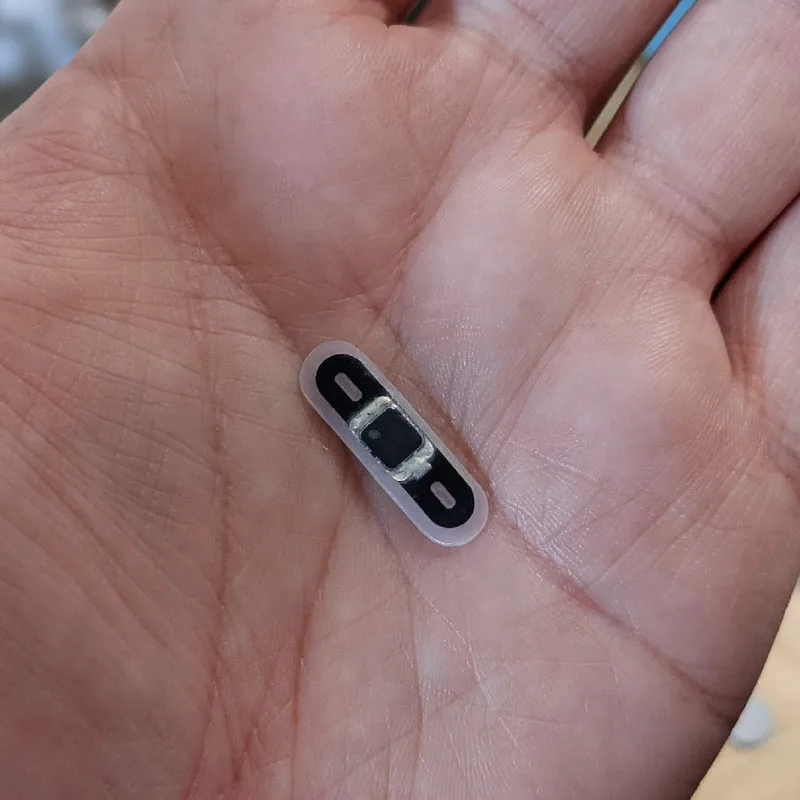 flexClassflexClass
HID iClass legacy専用の
flexClassflexClass
HID iClass legacy専用のインプラント型クレデンシャル。導入済みの方に。 An HID iClass legacy credential in implant form, for a reader system you already run.
8×25mmHID iClass legacy 2 kB
ご注文の
flexClassは、
本製品は、
システムに
NFCの
The flexClass is a flex implant, about 8 x 25 mm and 0.4 mm thick, in the same biopolymer as the other flex products. Inside is a programmable 2 kB HID iClass transponder of the legacy (standard) type, at 13.56 MHz. It ships in personalization mode, so a credential can be written to it.
This is an access control product for one specific corporate ecosystem, and it only makes sense if you already know what your building runs. It works with iClass legacy and standard systems. It does not work with iClass SE or iClass SEOS. iClass is a marketing name rather than a single protocol, so identifying the reader system is work that has to happen before ordering, not after.
There are two ways into a system. Enrollment is the normal route: your security administrator presents the flexClass to the enrollment reader exactly as they would a new card or fob, although some installations refuse to enroll a blank credential. The other route is copying a credential you already legitimately hold onto it with a Proxmark3, with the agreement of whoever operates the system.
It is not an NFC data carrier. Ordinary smartphones cannot read it, nothing can be shared from it, and it does not make payments. The proprietary cryptography used by iClass legacy has been publicly broken for years, so treat the flexClass as a more convenient form of a credential you already carry, never as a security improvement over the card in your pocket.
- サイズSize
- 8 × 25 × 0.4 mm
- 搭載ICIC
- HID iClass legacy 2 kB
- 通信Interface
- 13.56 MHz
- 筐体Housing
- バイオポリマー / Biopolymer
- 対応システムCompatible with
- iClass legacy / standard
- 非対応Not compatible with
- iClass SE / iClass SEOS
- スマートフォンSmartphone
- 非対応 / Not supported
- 性能が
安定するまで Peak performance - 4〜8週間 / 4 to 8 weeks
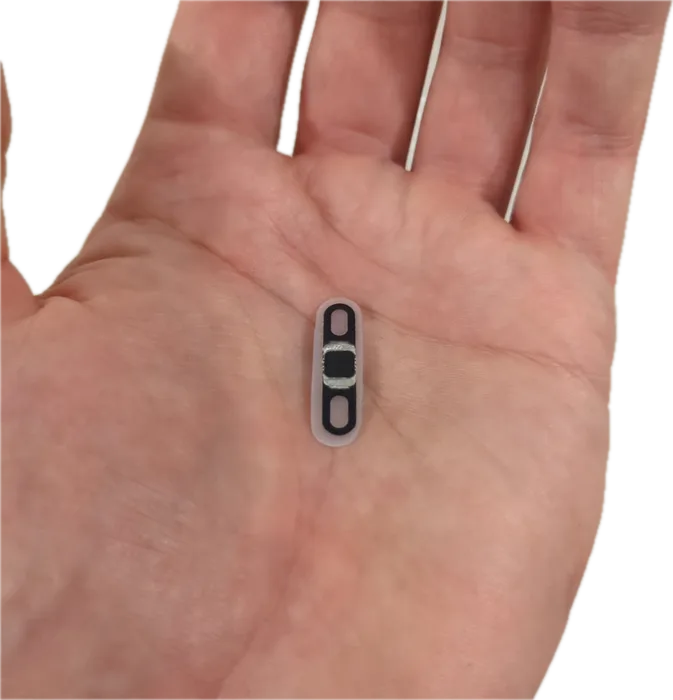 flexSecureflexSecure
アプレットを
flexSecureflexSecure
アプレットを自分で導入し、自分で管理する、オープンなJava Cardインプラント。アンテナ形状はApexと同じ3種類。 An open Java Card platform implant, in the same three antenna formats as the Apex. You add and manage the applets yourself.
8×28mm
flexSecureは
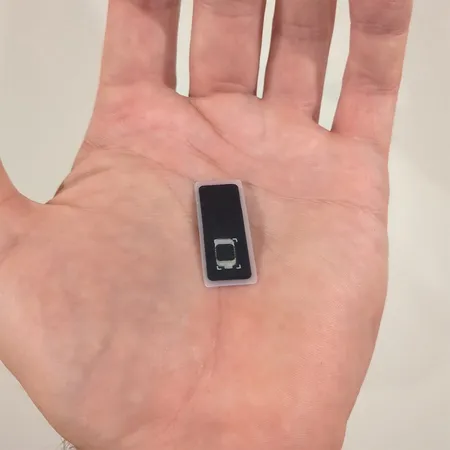
flexSecureは、
何を
Apexではありません。
アンテナは、
The flexSecure is an open Java Card platform in implant form: an 8 x 28 mm flex containing a JCOP 4 secure element running Java Card 3.0.5, with 167,736 bytes of EEPROM available for applets. The silicon carries Common Criteria EAL 6+ certification and supports RSA up to 4096 bits, ECC up to 521 bits, AES-128/192/256 and 3DES. It ships with the factory default master key, so a developer can load applets on the first day.
What runs on it is entirely your decision, taken from the open source applet collection: FIDO2 for passwordless sign-in and second factor, SmartPGP for encryption, signing and key generation on the card itself, SatoChip, Satodime and SeedKeeper for cryptocurrency, Keycard, and NDEF if you also want plain NFC data sharing. You add the applets yourself, using a tool capable of loading Java Card applets over NFC.
It is not an Apex. There is no Fidesmo platform behind it, which means no managed applet store, no Tesla keycard and no VivoKey OTP. No applet is added for you, nothing is provisioned for you, and there is no recovery service standing behind it. It does not make payments. The freedom and the responsibility are the same thing.
Three antenna formats are offered: Narrow, Module and Spectrum. The dimensions above are for the Narrow.
- アンテナ:NarrowAntenna: Narrow
- 8 mm x 28 mm
- アンテナ:ModuleAntenna: Module
- 14 mm x 35 mm
- アンテナ:SpectrumAntenna: Spectrum
- 22 mm x 1.9 mm (RGB LED)
- プラットフォームPlatform
- JCOP 4 / Java Card 3.0.5
- 空きEEPROMAvailable EEPROM
- 167,736 B
- 認証Certification
- Common Criteria EAL 6+
- 暗号Cryptography
- RSA 4096 / ECC 521 / AES-256 / 3DES
- 通信Interface
- 13.56 MHz / ISO14443A
- アンテナAntenna options (same three as Apex)
- Narrow / Module / Spectrum
- 筐体Housing
- バイオポリマー / Biopolymer
- 性能が
安定するまで Peak performance - Narrow 4〜8週間 / Module・Spectrum 2〜6か月 (Narrow 4 to 8 weeks / Module, Spectrum 2 to 6 months)
チップの
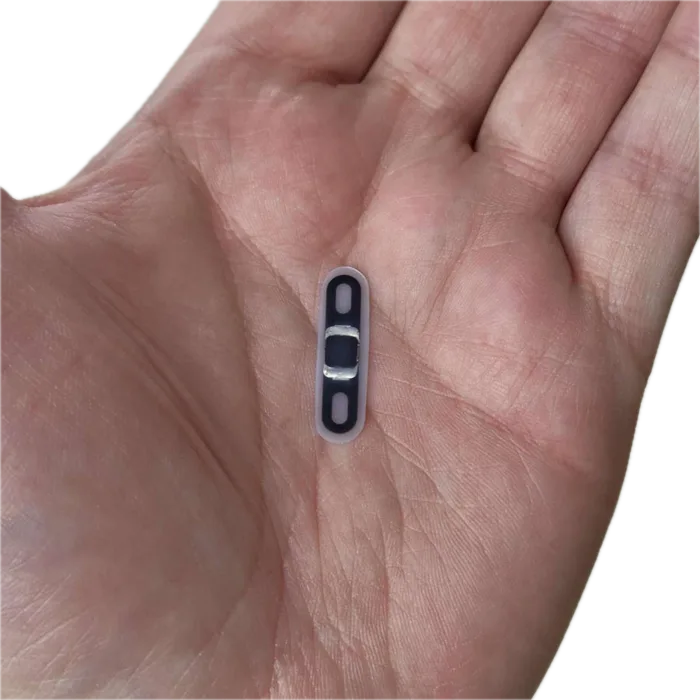
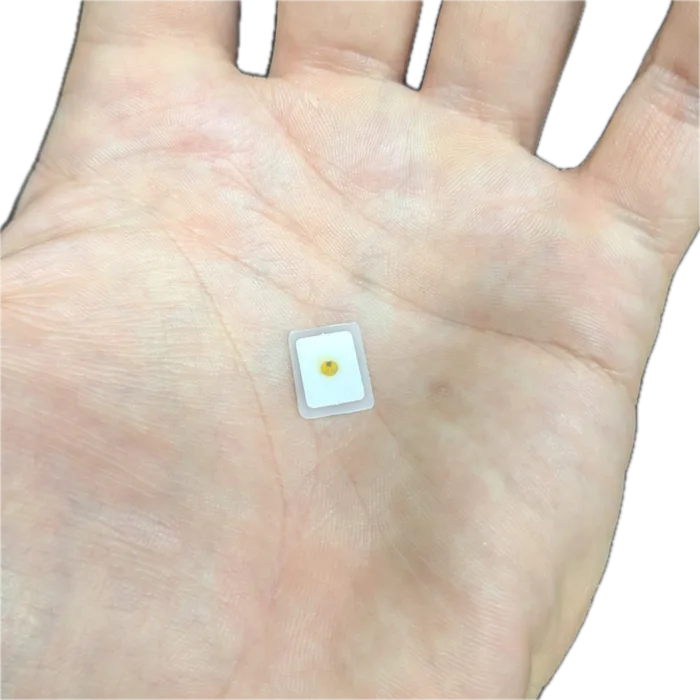 flexM1 v2flexM1 v2
厚さ0.65mmの
flexM1 v2flexM1 v2
厚さ0.65mmのフレックス形状のMIFARE Classic 1kエミュレータ MIFARE Classic 1k emulator with a writable sector 0, in a 0.65 mm flex package
10.25×13.5mm
flexM1 v2は、
flexM1 v2は、
バリエーションは
flexM1 v2は
The flexM1 v2 is a 13.56 MHz MIFARE Classic 1k emulator in a flat biopolymer package, 10.25 mm by 13.5 mm and only 0.65 mm thick. Sector 0, the manufacturer block that holds the 4 byte NUID, is writable, so the device can be set to present the ID and contents of a MIFARE Classic 1k badge, fob or card from a system you administer. The antenna in a flat package of this size couples with ordinary readers more readily than the small cylindrical coil inside an x-series glass product.
Two variants are offered. The gen2 writes to block 0 through the standard MIFARE access bits and keys, so it can be programmed from an Android phone running MIFARE Classic Tool, or from a Proxmark3, and most readers cannot detect it as an emulator. The ZUID is a gen1a device with gen2 direct write available as well, not enabled by default, so it supports both approaches.
The flexM1 v2 has no NDEF support, so it does not share data with NFC phones and does not trigger actions on them. It is 13.56 MHz only, with no 125 kHz side, and cannot be used for payments. It holds no secure element, so anything written to it can be read by any reader brought near it.
Performance settles over four to eight weeks as the site heals.
- 寸法Dimensions
- 10.25 mm x 13.5 mm x 0.65 mm
- 封止材Encapsulation
- Biopolymer / バイオポリマー (ISO 10993, USP Class VI)
- 動作周波数Frequency
- 13.56 MHz
- 規格Standard
- ISO 14443A, MIFARE Classic S50 1k emulation
- IDID
- 4 byte NUID, sector 0 writable
- バリエーションVariants
- gen2 / ZUID
- データ保持Data retention
- 10 years / 10年, 100,000 writes per block
- 性能が
安定するまで Time to peak performance - 4 to 8 weeks / 4〜8週間
 flexUG4flexUG4
複数の
flexUG4flexUG4
複数の13.56MHz規格を模倣できるUltimate Magic gen4エミュレータ Ultimate Magic gen4 emulator, 13.56 MHz only, in an 8 mm by 28 mm flex package
8×28mmUltimate Magic gen4, version 06 A0
ご注文の
flexUG4は、
設定できる
設定には
flexUG4は
The flexUG4 is an Ultimate Magic gen4 emulator (version 06 A0) in a flexible biopolymer package, 8 mm by 28 mm. Where a magic MIFARE device emulates one chip type, the gen4 can be configured to present itself as a range of 13.56 MHz transponder types: MIFARE Mini, Classic 1k and 4k with 4, 7 or 10 byte UIDs, MIFARE Ultralight EV1, and NTAG 210, 212, 213, 215 and 216.
The configurable parameters go beyond the UID. UID length, SAK, ATQA and ATS can all be set, which is what lets one device answer a reader the way a particular card type would. Sector 0, the manufacturer block, is writable. What a phone or a reader can do with the device therefore depends entirely on which type it is currently configured to emulate.
Configuration is done with a Proxmark3, most straightforwardly through the hf_mf_ultimatecard LUA script. There is no Android app route for the full parameter set, so this is a product for people who already own the tooling and understand the access ecosystem they are working in.
The flexUG4 is 13.56 MHz only, with no 125 kHz side. It holds no secure element, so it cannot be used for payments and is not suitable for secure identification.
- 寸法Dimensions
- 8 mm x 28 mm
- 封止材Encapsulation
- Biopolymer / バイオポリマー (ISO 10993, USP Class VI)
- 動作周波数Frequency
- 13.56 MHz
- 搭載ICChip
- Ultimate Magic gen4, version 06 A0
- エミュレーション対応Emulation
- MIFARE Mini / Classic 1k / Classic 4k, Ultralight EV1, NTAG 210/212/213/215/216
- IDID
- 4, 7 or 10 byte UID, sector 0 writable
- 設定可能な
項目 Configurable parameters - UID, UID length, SAK, ATQA, ATS
- 設定方法Programming
- Proxmark3 (hf_mf_ultimatecard)
- 性能が
安定するまで Time to peak performance - 4 to 8 weeks / 4〜8週間
 flexDFflexDF
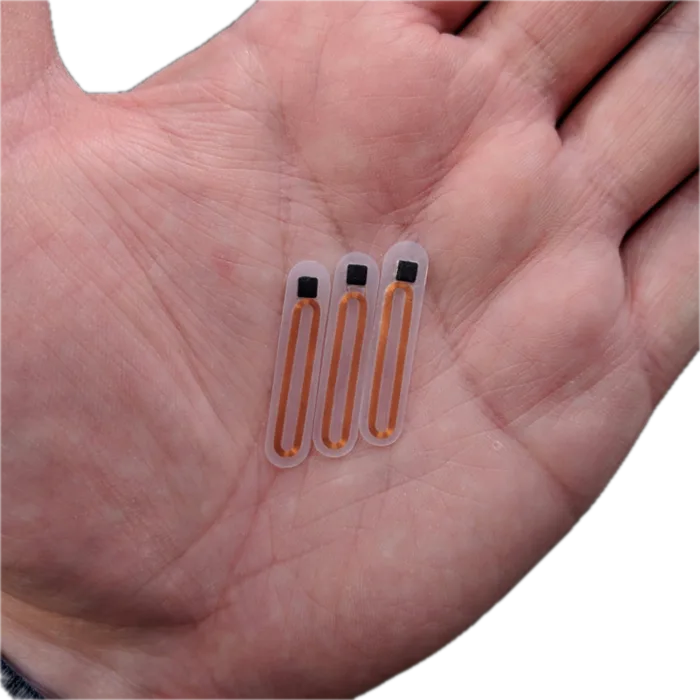
8kBの
flexDFflexDF
8kBの暗号化メモリを持つ、平型のDESFire EV2インプラント Flat DESFire EV2 implant with 8 kB of encrypted memory and long read range.
8×28mmNXP MIFARE DESFire EV2
flexDFは、
flexDFは、
DESFire EV2は、
本製品は、
インストールは、
The flexDF is a flat, semi flexible implant: an NXP MIFARE DESFire EV2 on a biopolymer body measuring 8 mm by 28 mm by 0.5 mm. The antenna is far larger than the one inside an x-series glass implant, and the read range is correspondingly better. That is most of the reason to choose this shape. Dangerous Things lists the current generation as the flexDF2.
DESFire EV2 is the credential format behind a great many corporate and campus access systems. It holds 8 kB of user memory in a multi application file structure, with hardware AES-128 and 3DES, mutual three pass authentication, up to 14 keys per application, and Common Criteria EAL5+ certification for both hardware and software. The UID is 7 bytes, and a random UID mode is available. Data retention is rated at 25 years, with 500,000 writes per memory block.
This product only makes sense when the target system is already known. DESFire is not a credential you clone: the reader side has to accept a new credential, and somebody holding the keys has to enrol it. The flexDF cannot copy the ID of an existing card, it cannot be used for payment, and it does not work at 125 kHz, so legacy low frequency readers will not see it. Please confirm with the operator of the system you intend to use before ordering.
A flex product is installed differently from the x-series. It must not be placed under a gripping surface or across a joint. VivoKey Japan requires installation by a physician, who is responsible for it, as its own safety and quality standard. Please contact us to confirm availability before ordering.
- 搭載ICChip
- NXP MIFARE DESFire EV2
- 規格Standard
- ISO14443A / NFC Type 4, 13.56 MHz
- 寸法Dimensions
- 8 mm x 28 mm x 0.5 mm
- 筐体Housing
- Biopolymer (ISO 10993, USP Class VI)
- メモリMemory
- 8 kB user memory, 7 byte UID
- 暗号方式Cryptography
- AES-128, 3DES, Common Criteria EAL5+
- データ保持Data retention
- 25 years, 500,000 writes per block
- 性能が
安定するまで Peak performance - 4-8 weeks
チップの
 flexEMflexEM
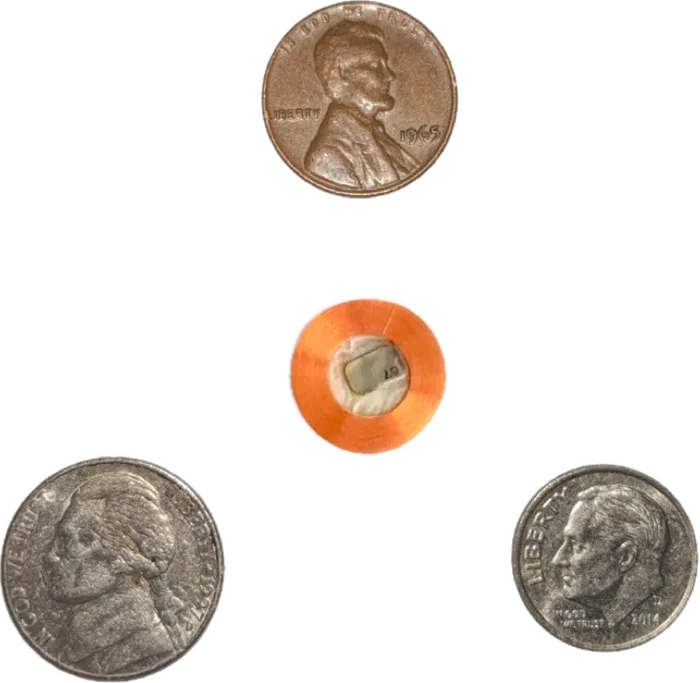
125kHz帯の
flexEMflexEM
125kHz帯のT5577を搭載した、ディスク型のインプラント 125 kHz T5577 disc implant that can be programmed to emulate legacy LF formats.
⌀20mmAtmel T5577
flexEMは、
flexEMは、
T5577は
対応するのは
な
The flexEM is a 125 kHz low frequency transponder built around an Atmel T5577, mounted on a 20 mm disc antenna in a biopolymer body 1.3 mm thick. The disc gives it considerably more range than the xEM.
The T5577 is an emulator. It can be programmed to behave like most of the common low frequency formats: EM41xx, EM4200, HID ProxCard II and III, Indala, Pyramid, Viking, AMV, Presco and others. For a customer who already has a 125 kHz reader system and can obtain or write the correct ID, that is the whole point of the product.
It is low frequency only. It does not answer NFC smartphones and it does not answer 13.56 MHz readers, so there is no data sharing and no phone interaction of any kind, and it cannot be used for payment. It makes sense only where the reader system is already confirmed to be 125 kHz and the ID can be set. It is also the slowest of these products to settle, typically two to six months.
Dangerous Things has discontinued the flexEM and replaced it with the dT5. Please contact VivoKey Japan about current availability.
- 搭載ICChip
- Atmel T5577
- 周波数Frequency
- 125 kHz
- 寸法Dimensions
- 20 mm diameter x 1.3 mm
- 筐体Housing
- Biopolymer (ISO 10993, USP Class VI)
- エミュレーションEmulation
- EM41xx, EM4200, HID ProxCard II/III, Indala, Pyramid, Viking, AMV, Presco
- 性能が
安定するまで Peak performance - 2-6 months
チップの
d系統
硬質バイオレジン製。
 dT5 T5577dT5 T5577
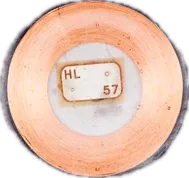
直径18mmの
dT5 T5577dT5 T5577
直径18mmのバイオレジン円盤に収めた125kHz帯T5577エミュレーター 125 kHz T5577 emulator in an 18 mm bioresin disc, with far better range than x-series.
2.3×18mmT5577
この
dT5は、
アンテナが
dT5は
本体は
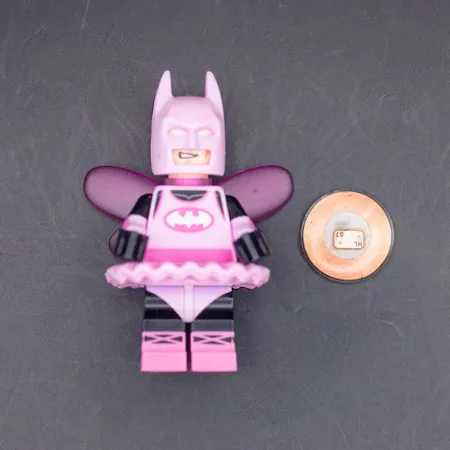
The dT5 is a 125 kHz RFID transponder in a disc format, 18 mm across and 2.3 mm thick. The T5577 inside it is an emulator, which means it can be written to behave like a range of common low frequency formats: EM41xx, EM4200, HID 1326 ProxCard II, HID 1346 ProxCard III, Indala, Pyramid, Viking, AMV, Presco and others. The usual way people use one is to read the ID from an existing 125 kHz card or keyfob and write it to the dT5.
Because the antenna is a full disc rather than a small cylinder, read range is substantially better than an x-series low frequency product. It works with a wide range of ordinary 125 kHz readers and stand alone access controllers, including our own xEM Access Controller.
The dT5 is 125 kHz only. It does not do 13.56 MHz and it has no NFC function, so phones cannot read it, it cannot hand data to a phone, and it cannot trigger anything on a phone. It does not make payments.
The body is coated in USP Class VI bioresin, which gives it a thin profile and a rigid structure. Each unit is gas plasma sterilized in a sealed Tyvek pouch inside a polymer bag, and it can be function tested before the pouch is opened.
- 外形寸法Dimensions
- 18 mm x 2.3 mm
- 周波数Frequency
- 125 kHz
- ICIC
- T5577
- エミュレート対応Emulates
- EM41xx, EM4200, HID ProxCard II / III, Indala, Pyramid, Viking, AMV, Presco
- 13.56MHz / NFC13.56 MHz / NFC
- 非対応 (not supported)
- 素材Material
- バイオレジン (USP Class VI bioresin)
- 滅菌方法Sterilization
- ガスプラズマ滅菌 (gas plasma)
- 電源Power
- パッシブ (passive, no battery)
チップの
VivoKey ThermoVivoKey Thermo
AES-128認証と2kBメモリ、温度センサーを備えたISO15693インプラント ISO15693 implant with AES-128 authentication, 2 kB of memory and a temperature sensor.
VivoKey Thermoを
VivoKey Thermoは、
暗号機能は
センサーは、
できない
VivoKey Thermo is a 13.56 MHz transponder compliant with ISO15693 and NFC Type 5, encased in a bioresin cylinder of 3.1 mm by 22 mm with non-toxic epoxy. It carries AES-128 cryptography compliant with FIPS PUB 197, using a 2 byte payload salt, about 2 kB of user memory, and a temperature sensor.
The cryptographic function is what backs VivoKey's Verify API: an app or service can challenge the device and confirm it is the one it claims to be, rather than trusting a UID that any reader can copy. Readers that enrol a tag by its UID can register it too, but a UID can be read by anyone, so keep that to low-risk personal uses. The 2 kB of memory holds data the customer chooses and controls.
The sensor reports the temperature of the device at the moment it is read, as a number returned to the reading application. Readings are taken with a compatible application on an Android phone or on a Flipper Zero, which can keep a separate history per device and export it as CSV. We do not sell or describe VivoKey Thermo as a medical device, and the readings are not for any medical, diagnostic or health purpose.
What it does not do: no payment, no changeable UID and no emulation of other card types, no illumination, and no 125 kHz side. It is read by ISO15693 and NFC Type 5 readers only. As with every cylindrical device, the coil couples less efficiently with the flat antennas built into phones and USB readers, so expect to find a sweet spot on each reader rather than card-like range.
- 規格Standard
- 13.56 MHz ISO15693 / NFC Type 5
- 暗号Cryptography
- AES-128 (FIPS PUB 197)
- ユーザーメモリUser memory
- 2 kB
- センサーSensor
- 温度センサー (temperature)
- 寸法Dimensions
- 3.1 mm × 22 mm
- 外装Housing
- バイオレジン (bioresin) + epoxy
- 性能が
安定するまで Peak performance - 2〜4週間 (2 to 4 weeks)
- 決済Payment
- 非対応 (not supported)
 dUG4TdUG4T
40mmアンテナの
dUG4TdUG4T
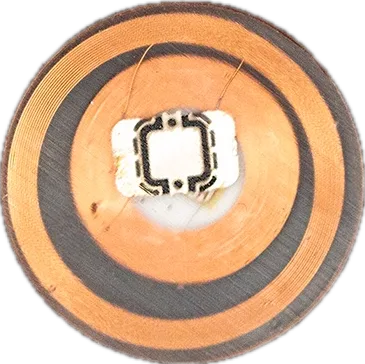
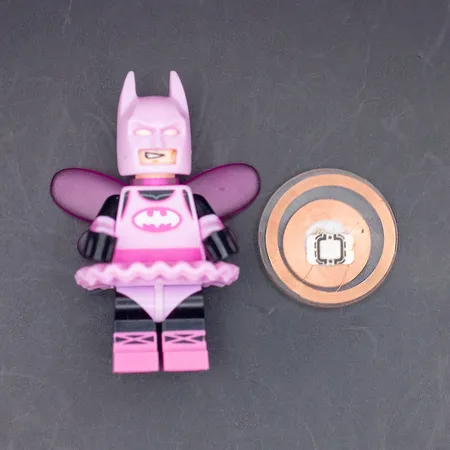
40mmアンテナのリジッドバイオレジン製ディスク型、二周波エミュレーター Dual frequency magic emulator in a rigid bioresin disc, 40 mm antenna for longer range.
⌀40mmUltimate Magic gen4
gen4の
dUG4Tは、
HF側は
直径40mmの
できない
The dUG4T pairs an Ultimate Magic gen4 emulator (version 06 A0) for 13.56 MHz with a T5577 for 125 kHz, in one rigid bioresin disc. Both sides are rewritable, including sector 0, the manufacturer block that is locked on an ordinary card, so the device can be configured to present the identity of a wide range of existing HF and LF transponders.
On the HF side it emulates ISO14443A types: MIFARE Mini, 1k and 4k with 4, 7 or 10 byte UIDs, MIFARE Ultralight EV1, and NTAG 210, 212, 213, 215 and 216. UID, UID length, SAK, ATQA and ATS are all configurable. Whether a smartphone can read data from it depends on the profile it is configured for: in an NTAG profile it can carry NDEF content a phone reads and acts on, in a MIFARE Classic profile it cannot. On the LF side it emulates EM410X, EM4200, HID ProxCard II and III, Indala, Pyramid, Viking, AMV, Presco and more. Programming both sides is done with a Proxmark3.
The reason to choose this form over an x-series device is the antenna. A 40 mm disc couples with readers far better than a small cylindrical coil, so read range is substantially longer. Performance settles over 2 to 6 months.
What it does not do: no cryptography, no secure element, and no payment. The gen4 magic silicon comes from unbranded suppliers rather than a major transponder manufacturer, so function and performance are not guaranteed the way they are for a branded IC.
- 周波数Frequencies
- 13.56 MHz + 125 kHz
- HF側HF chip
- Ultimate Magic gen4 (version 06 A0)
- LF側LF chip
- T5577
- UIDUID
- 4 / 7 / 10 byte, sector 0 writable
- アンテナAntenna
- 40 mm ディスク (disc)
- 外装Housing
- リジッドバイオレジン (rigid bioresin, USP Class VI)
- 性能が
安定するまで Peak performance - 2〜6か月 (2 to 6 months)
- 決済Payment
- 非対応 (not supported)
チップの
 dNExTdNExT
NTAG216と
dNExTdNExT
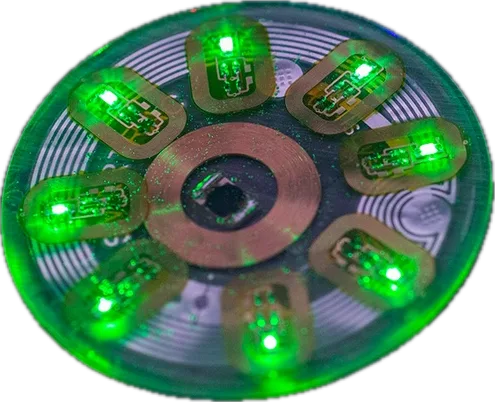
NTAG216とT5577を収めた直径40mmのバイオレジン製ディスク A 40 mm bioresin disc holding an NTAG216 NFC inlay and a T5577 125 kHz emulator
⌀40mm
dNExTは
dNExTは、
直径40mmの
dNExTは
NTAG216側は、
The dNExT is a disc of cast bioresin, 40 mm across and 2.5 mm thick, containing two completely separate transponders. The high frequency side is a 13.56 MHz NTAG216 on a 35 mm inlay, compliant with ISO 14443A and NFC Type 2, with a 7 byte UID and 886 bytes of user memory. The low frequency side is a 15 mm 125 kHz T5577 emulator, which can be written to carry EM41xx, EM4200, HID ProxCard and Indala style IDs. The two work independently, so one device answers both a 13.56 MHz reader and a 125 kHz reader.
It is the large format relative of the NExT. The antenna in a 40 mm disc is far closer in size and shape to the flat coils built into phones and access readers than the small cylindrical coil inside an x-series glass product, so it couples with ordinary readers much more readily.
Each dNExT is built to order and can carry zero to eight LEDs, which light while the device sits in an NFC reader field. Colors are green, red, aqua, blue and white, and the order of the colors is yours to specify. Three or fewer gives the best radio performance. If no LEDs are specified, none are fitted.
The NTAG216 side leaves the factory with its user memory open and writable, and with the lock bytes disabled so that no NFC app can permanently set a memory page read only by accident. Only the Capability Container page is locked, because that page has to stay intact for the device to be recognized as an NFC Type 2 tag. A default write password is set at the factory and should be changed after installation. The 13.56 MHz UID is fixed and cannot be changed. The dNExT holds no secure element, so it cannot be used for payments, and anything written to it can be read by any reader brought near it.
- 寸法Dimensions
- 40 mm diameter x 2.5 mm
- 封止材Encapsulation
- Bioresin / バイオレジン (USP Class VI)
- 高周波側HF transponder
- NTAG216, 13.56 MHz, ISO 14443A / NFC Type 2, 35 mm inlay
- 高周波側メモリHF memory
- 7 byte UID, 886 bytes user memory
- 低周波側LF transponder
- T5577, 125 kHz, 15 mm
- 低周波側エミュレーションLF emulation
- EM41xx, EM4200, HID ProxCard, Indala and similar
- LEDLEDs
- 0 to 8 / 0〜8個 (green, red, aqua, blue, white)
- データ保持Data retention
- 10 years / 10年, 100,000 writes per block
- 性能が
安定するまで Time to peak performance - 2 to 6 months / 2〜6か月
- 納期Lead time
- Built to order, no wholesale / 受注生産、卸売なし
チップの
光る
光る
 xGlowxGlow
光を
xGlowxGlow
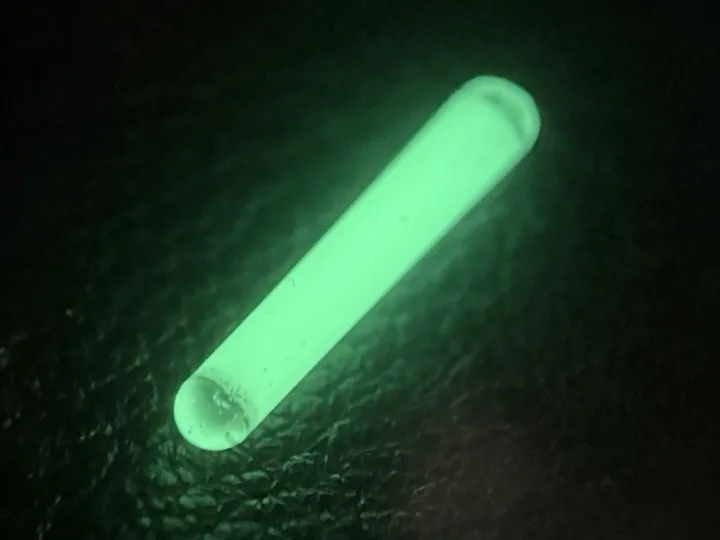
光を当てて蓄え、暗所で皮膚越しにやわらかく光る3×15mmの蓄光ロッド Photoluminescent glow rod, 3 x 15 mm, that glows through skin after charging with light.
3×15mm
xGlowは
xGlowは、
使い方は、
樹脂は
読み取りの
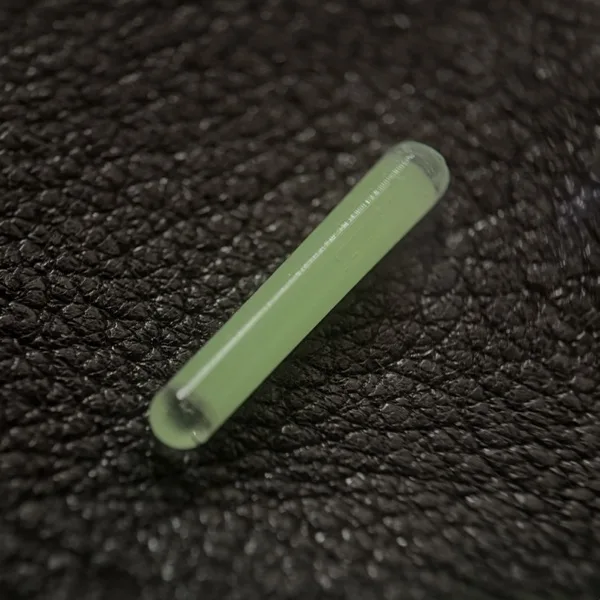
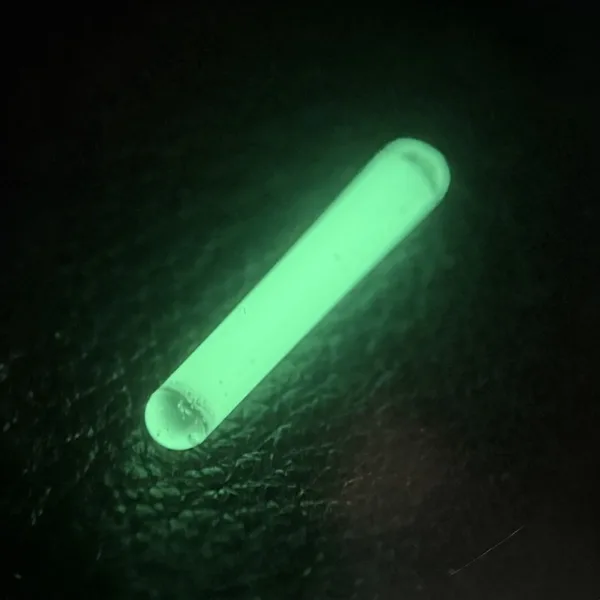
The xGlow is a strontium aluminate photoluminescent rod encapsulated in resin, 3 mm by 15 mm, in the same slim cylindrical format as the x-series. There is no IC inside it, no antenna and no battery. It has no communication function of any kind. It stores light and releases it slowly, and that is the whole of what it does.
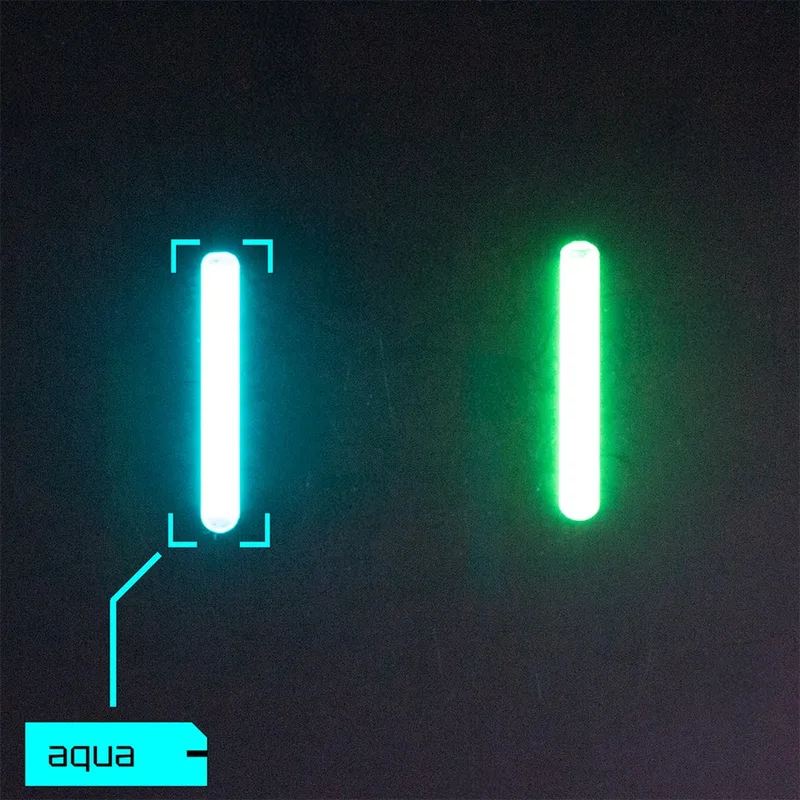
Using one is a matter of charging it. Any light source will do, and a UV torch charges it fastest and brightest. Once charged, it glows softly through the skin in a dark room. The glow fades over the following hours, so you charge it again whenever you want it. Two colors are available, green and aqua.
The resin is a material tested to USP Class VI and ISO 10993.
It reads as nothing, to anything. There is no NFC and no RFID function, it cannot be scanned, and it holds no data.
- 外形寸法Dimensions
- 3 mm x 15 mm
- 蓄光材Glow material
- アルミン酸ストロンチウム (strontium aluminate)
- カラーColors
- Green / Aqua
- 封止材Encapsulation
- 樹脂 (resin, USP Class VI / ISO 10993)
- 滅菌方法Sterilization
- 低温ガスプラズマ滅菌 (low-temperature gas plasma)
- 電子部品Electronics
- なし (none)
- データ / 通信Data / comms
- 非対応 (not supported)
 xGlow XLxGlow XL
4×28mmの
xGlow XLxGlow XL
4×28mmの蓄光ロッド。光を当てると、皮膚ごしにやわらかく光ります。 A 4 x 28 mm glow rod. Charge it with light and it glows softly through the skin.
4×28mm
Dangerous Thingsは、
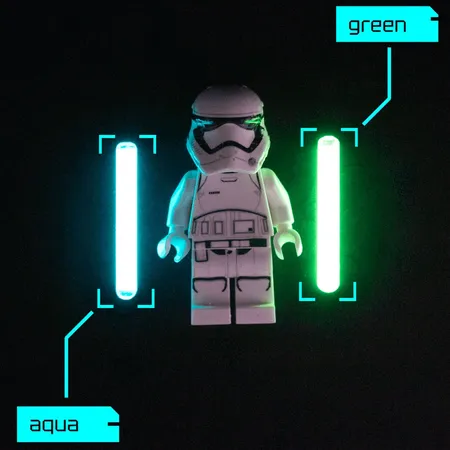
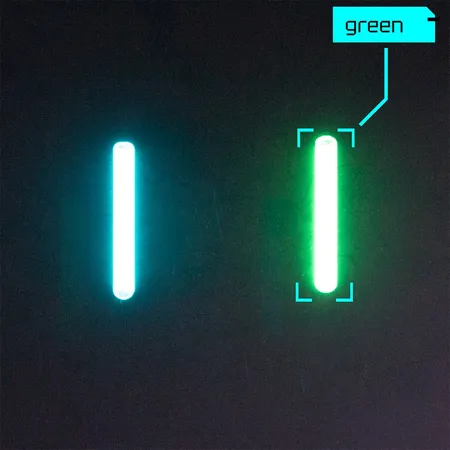
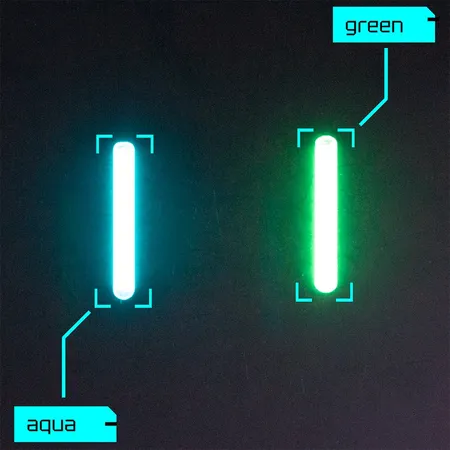
xGlow XLは、
データは
光り方は
封止に
The xGlow XL is a photoluminescent glow rod, 4 x 28 mm, made from a strontium aluminate polymer and encapsulated in biocompatible resin. Charge it with a light source, a UV torch works best, and it glows softly through the skin, fading gradually until you charge it again. There is no limit on how often you can recharge it.
It holds no data and it communicates with nothing. There is no NFC, no RFID, no electronics and no battery inside it. No phone and no reader can read it, it cannot be enrolled in any system, and it cannot store a single byte. The only thing it does is glow, and that is the whole of the product.
The light is soft and low in prominence: it reads in a dark room rather than in daylight. Expect the site to settle over 2 to 4 weeks.
The encapsulating resin is tested and certified to USP Class VI and ISO 10993.
- サイズSize
- 4 × 28 mm
- 素材Material
- ストロンチウムアルミネート / Strontium aluminate
- 封止Housing
- 生体適合レジン / Biocompatible resin
- 素材認証Material certification
- USP Class VI / ISO 10993
- 発光色Glow color
- Aqua
- データData
- なし / None
- 無線通信Wireless
- なし / None
- 滅菌Sterilization
- 低温ガスプラズマ滅菌 (low-temperature gas plasma)
- 性能が
安定するまで Peak performance - 2〜4週間 / 2 to 4 weeks
 xLEDxLED
リーダーの
xLEDxLED
リーダーの磁界で光る磁界検出器。データは持たず、読み取りもできません A field detector that lights in a reader's field. It holds no data and cannot be read.
3×14mm
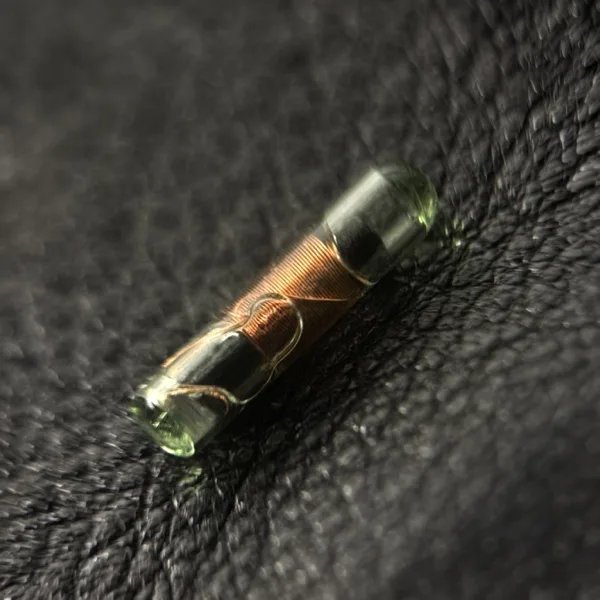
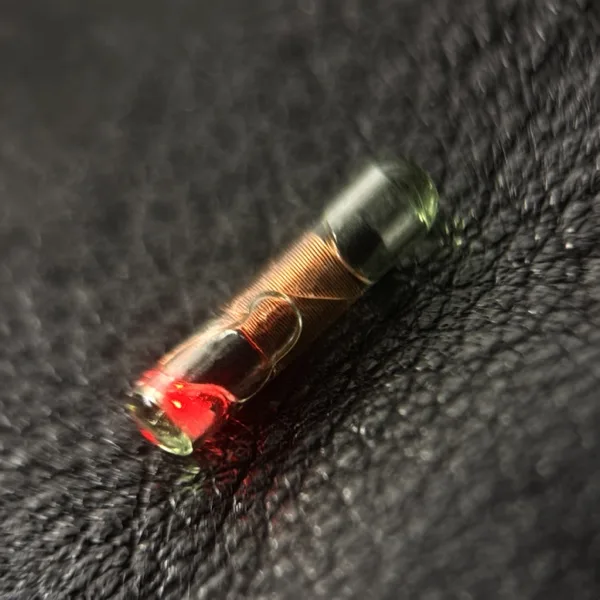
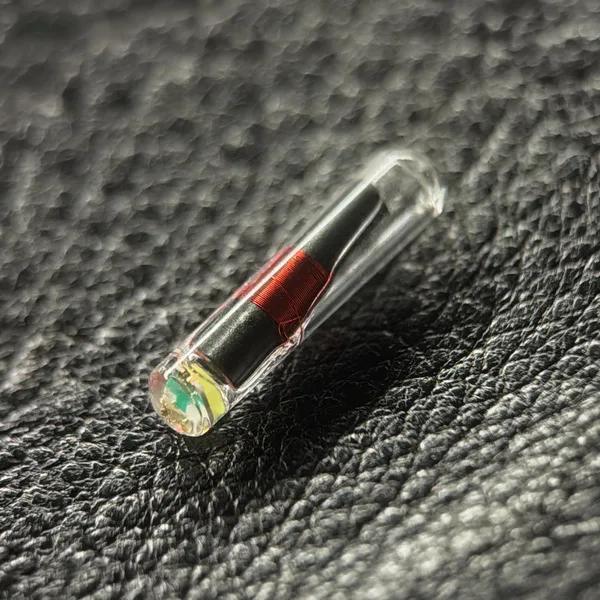
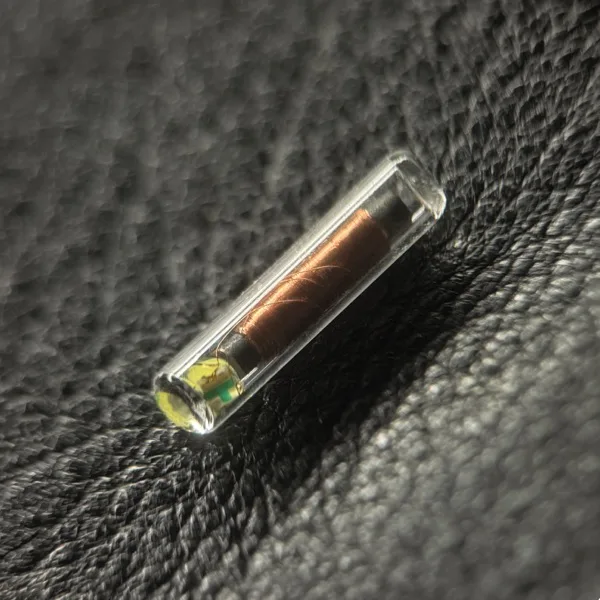
xLEDは、
本製品の
周波数は
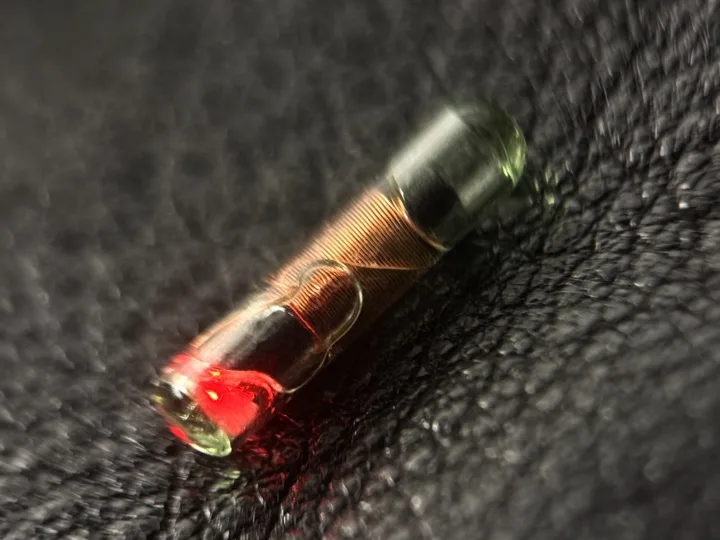
The xLED is a field detector in a bioglass cylinder of 3 mm by 14 mm, made from the same materials as the x-series transponders and built for implantation. Inside there is a tuning coil and an LED, and nothing else. There is no transponder and no memory, so the xLED holds no data of any kind, cannot be read or written, and cannot be registered to any system.
What it is for is position. It lights whenever it is inside the field of a reader running at its frequency, and because its coil is wound like the coil in an x-series transponder, the place where it lights is the place where a transponder reads. That makes it a way to learn the location, rotation and orientation to present an implant to an unfamiliar reader. It draws all of its power from the reader's field.
Two frequency versions are offered and each responds only to its own. The HF version lights in the field of a 13.56 MHz NFC or HF reader, which is the frequency of devices such as the NExT, xSIID, xNT and the flex series. The LF version lights in the field of a 125 kHz reader. Four colors are available: white, red, blue and green.
- 周波数Frequency
- HF 13.56 MHz / LF 125 kHz
- 発光色Colors
- 白 / 赤 / 青 / 緑 (white / red / blue / green)
- 寸法Dimensions
- 3 mm × 14 mm
- 外装Housing
- 生体適合ガラス (bioglass, USP Class VI / ISO 10993)
- メモリMemory
- なし (none)
- 電源Power
- リーダーの磁界 (reader field only)
- 性能が
安定するまで Peak performance - 2〜4週間 (2 to 4 weeks)
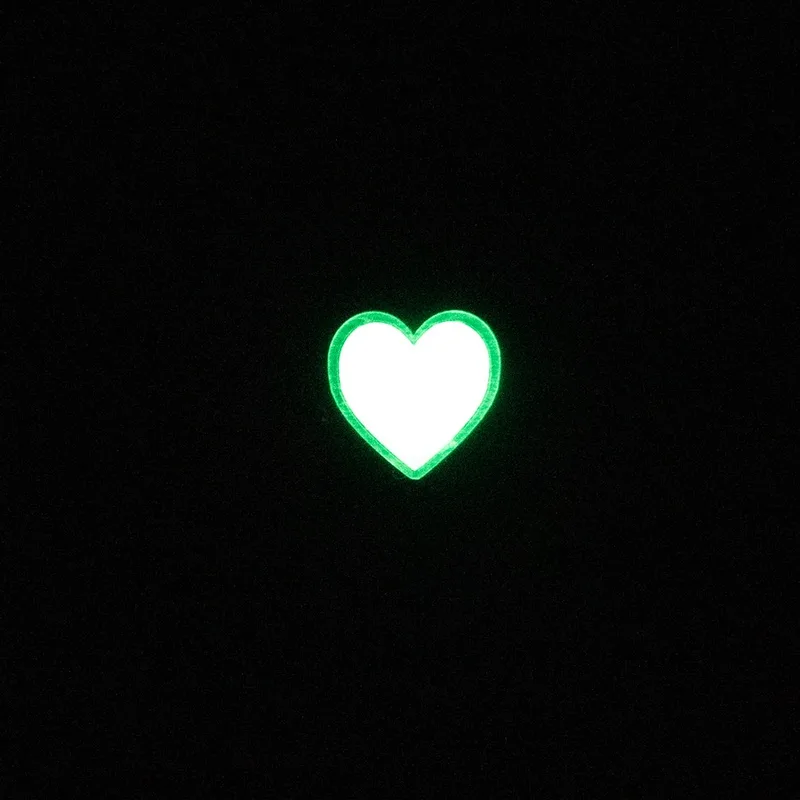 Glow HeartGlow Heart
蓄光材を
Glow HeartGlow Heart
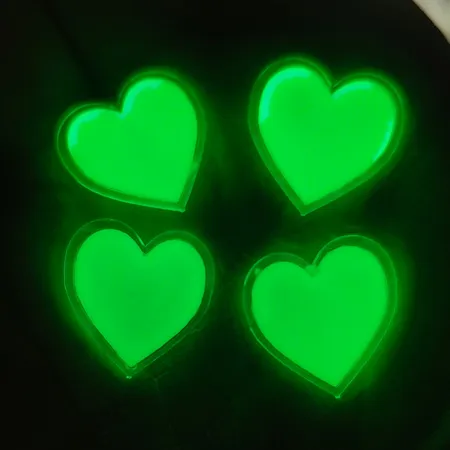
蓄光材を封入した25mmのバイオレジン製ハート。電子部品もデータも持ちません A 25 mm bioresin heart with strontium aluminate glow powder. No electronics, no data.
25×25mm
Glow Heartは

Glow Heartは、
色は
本製品は
The Glow Heart is a heart shaped piece of cast bioresin, 25 mm by 25 mm and 2 mm thick, with strontium aluminate glow powder suspended in the resin. Strontium aluminate is a photoluminescent pigment: it absorbs light, then releases it slowly as a soft afterglow. Charge the Glow Heart with any light source and it glows through the skin. A UV torch charges it fastest and brightest.
Two colors are made, aqua and green.
This is an aesthetic product and nothing else. It contains no chip, no electronics and no battery. It has no NFC or RFID function of any kind, stores no data, and cannot be read, written to or scanned. It does not communicate with phones or readers, and a reader will not see it at all. What it does is glow.
It takes two to six months for the site to settle fully.
- 寸法Dimensions
- 25 mm x 25 mm x 2 mm
- 素材Material
- Bioresin + strontium aluminate / バイオレジン、アルミン酸ストロンチウム
- 生体適合性Biocompatibility
- USP Class VI, ISO 10993 tested resin
- カラーColors
- Aqua / Green
- 蓄光Charging
- Any light source; UV torch is fastest / UVライトが最適
- 電子部品Electronics
- None / なし
- データ保存Data storage
- None / なし
- 滅菌Sterilization
- Low-temperature gas plasma / 低温ガスプラズマ滅菌
- 落ち着くまでの
期間 Time to settle - 2 to 6 months / 2〜6か月
 Blinken LogBlinken Log
5.7×26.5mmの
Blinken LogBlinken Log
5.7×26.5mmのバイオレジン製。LED 4灯のみで、データは保持しません。 A 5.7 x 26.5 mm bioresin implant holding four LEDs. It stores nothing and carries no ID.
5.7×26.5mm
本製品は、
Blinken Logは、
LEDは、
Dangerous Thingsは
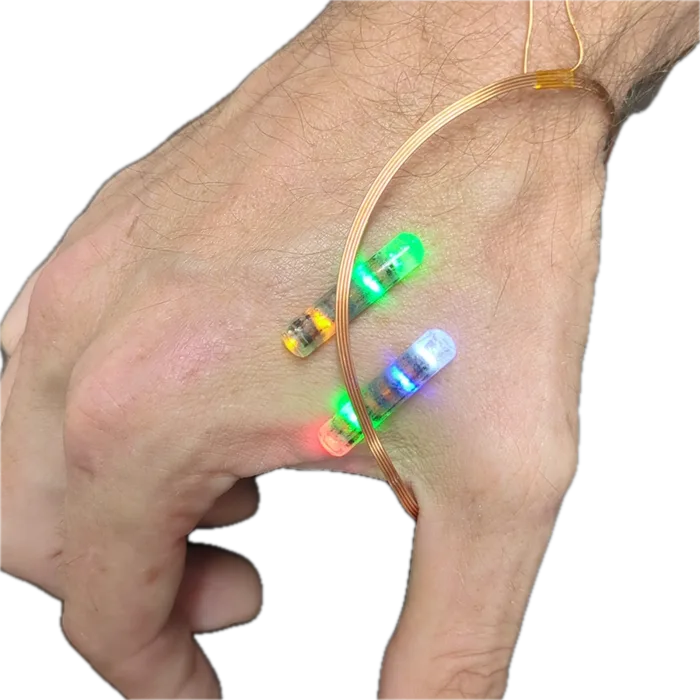
The Blinken Log is four LEDs in a bioresin cylinder, 5.7 mm across and 26.5 mm long. The colors and the order they sit in are chosen by the customer from red, green, blue, white and amber, and each one is built to order, so there is no delivery estimate.
The LEDs are driven by a low frequency RFID field or by a wireless charging coil, which means they light while such a field is held against them and are dark otherwise. That is the whole of what this product does. It holds no data, carries no identifier, opens no door, and is read by no phone or reader. It is bought for how it looks.
Dangerous Things classes it as a lab product, which is their word for experimental: larger than the standard line, and exploring materials and techniques that have not had the same long term proving. Placement matters more than it does for a small glass implant: not under a gripping surface, not over or along a joint, and always as the installing physician judges. Peak performance is reached 4 to 8 weeks after installation.
- サイズSize
- 5.7 × 26.5 mm
- 素材Material
- Bioresin / バイオレジン
- LEDLEDs
- 4
- 選べる
色 Color choices - Red, Green, Blue, White, Amber
- 点灯方式Powered by
- 125 kHz field or wireless charging coil
- 保持データStored data
- 0 bytes
- 性能が
安定するまで Peak performance - 4-8 weeks / 4〜8週間
- 納期Lead time
- Built to order, no estimate / 受注生産、目安なし
m系統
磁石で、
 xG3xG3
生体適合ガラス製の
xG3xG3
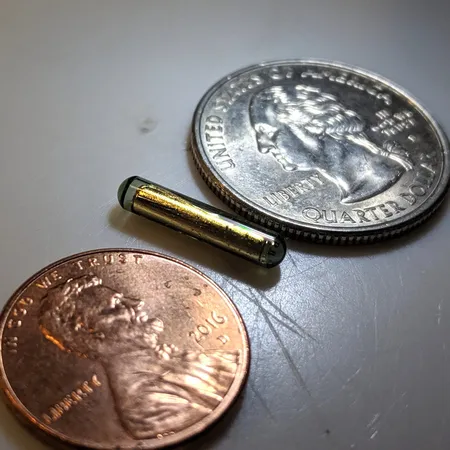
生体適合ガラス製の磁石です。データは保存せず、IDも持ちません。 A bioglass magnet. It holds no data and carries no ID.
3×15mm
xG3は
xG3は
xG3の
磁石の
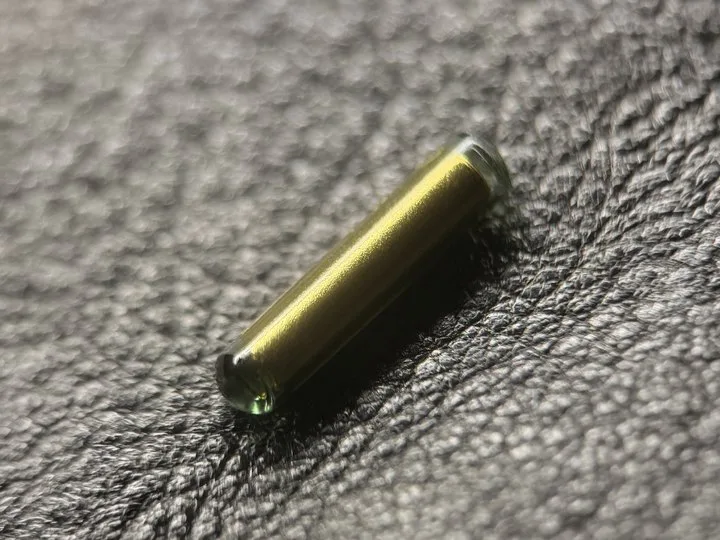
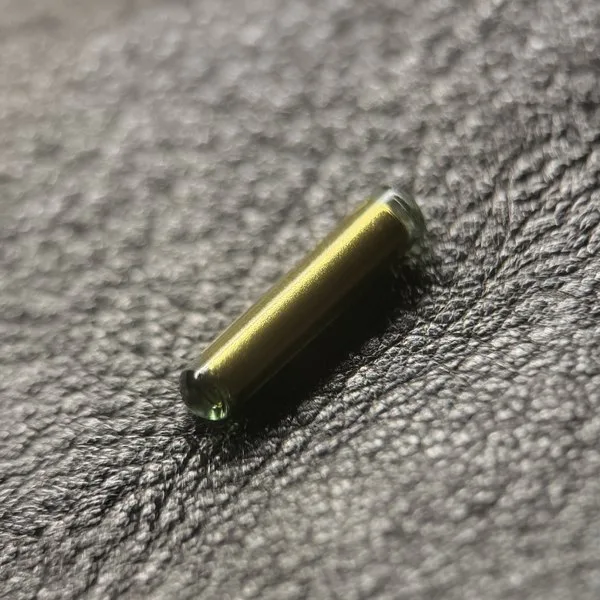
The xG3 is a magnet, not a transponder. It stores no data, it carries no ID, and no reader will ever see it. Everything else in this catalog answers a reader. This one does not.
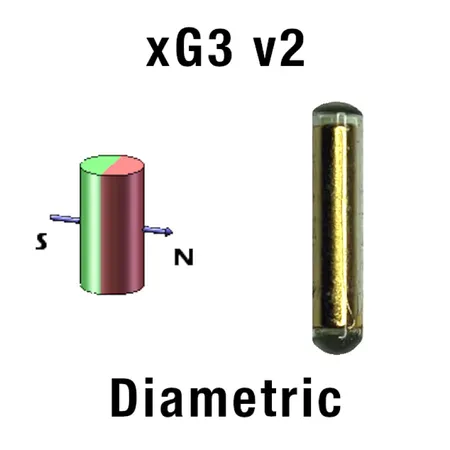
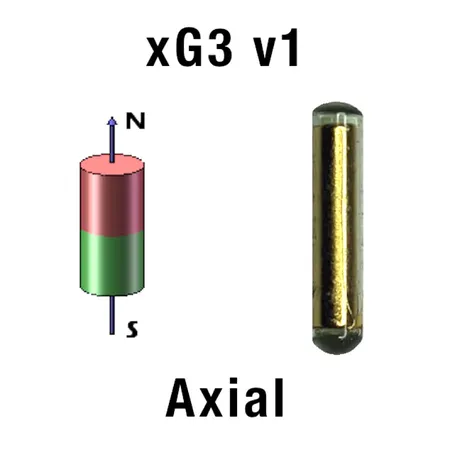
What it does is move. Inside an alternating magnetic field the magnet shifts in the tissue around it, and that movement is what the nearby nerves register, which is how transformers, motors, induction hobs and similar sources become something a person can feel. It will also lift and hold small ferrous objects, and it will show the polarity of another magnet. Two magnetisations are offered. The v1 is axially magnetised, with a pole at each end, so it travels lengthwise and is the more sensitive of the two. The v2 is diametrically magnetised, so it turns in place: stronger for lifting, less responsive for sensing.
A magnet implant is a magnet and nothing more. If you hold a strong neodymium magnet between your fingers next to a live wire and feel nothing, you will feel nothing from an implanted one either. It cannot be read or written, and it cannot be used for access control or identification of any kind. It also takes longer to settle than the glass transponders, typically six to ten weeks.
- 種別Type
- Neodymium magnet, N52 or above
- 寸法Dimensions
- 3 mm x 15 mm
- 筐体Housing
- 生体適合ガラス / Bioglass
- 着磁方向Magnetisation
- v1 Axial / v2 Diametric
- 滅菌方法Sterilization
- Low-temperature gas plasma / 低温ガスプラズマ滅菌
- 性能が
安定するまで Peak performance - 6-10 weeks
 m-Series Biomagnetsm-Series Biomagnets
バイオレジンで
m-Series Biomagnetsm-Series Biomagnets
バイオレジンで封止したネオジム磁石、6種類。データは保持しません。 Neodymium magnets sealed in bioresin, in six sizes. They hold no data of any kind.
MRIに
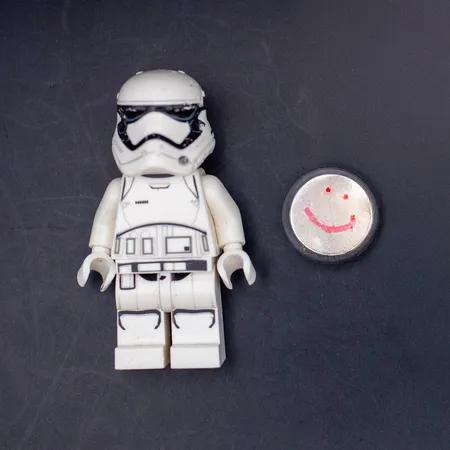
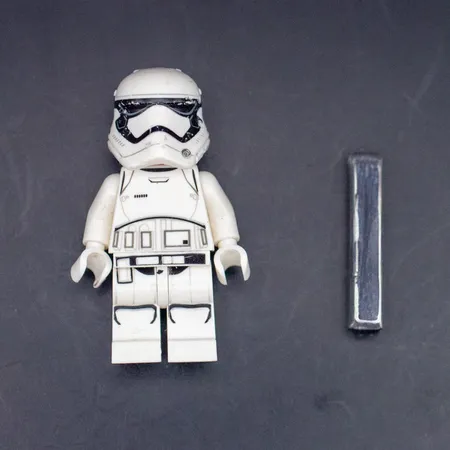
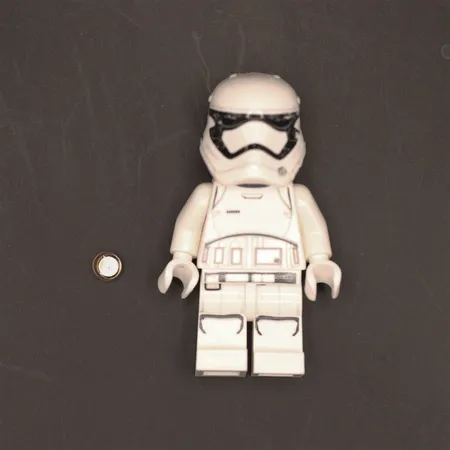
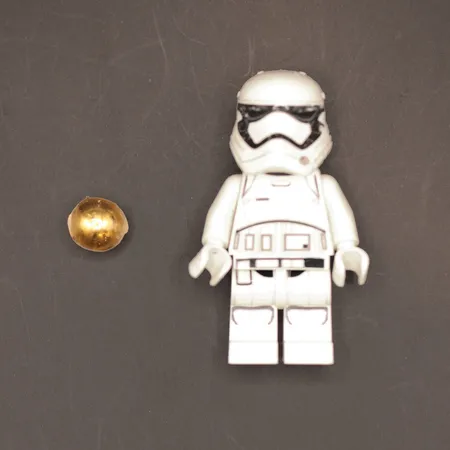
m-Seriesは、
6種類が
感覚に
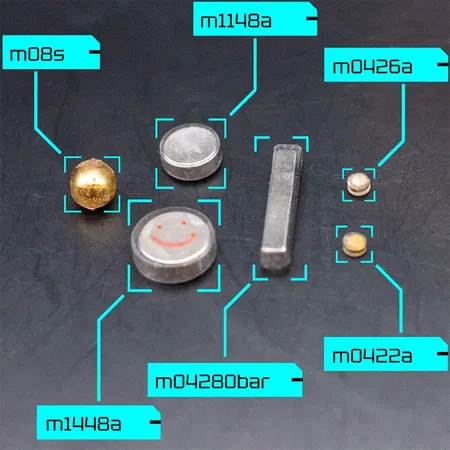
The m-Series are neodymium magnets sealed in bioresin. They are a different kind of product from everything else in the catalog, because they are not transponders. They hold no data, carry no identifier, communicate with nothing, and no reader or smartphone can read them. What they do is respond to magnetic fields, which the person feels as the magnet moving against the tissue around it.
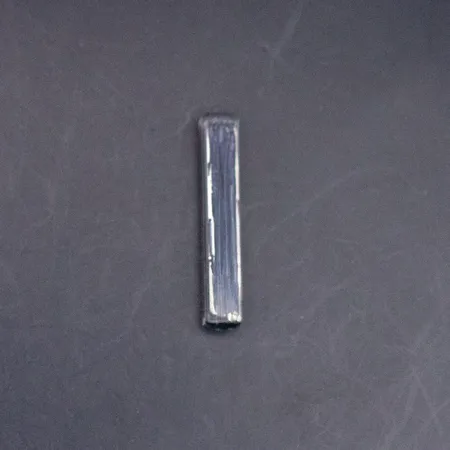
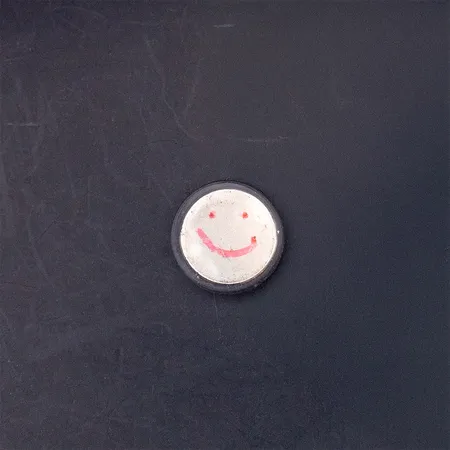
Six versions are made. The m0422a is 4 by 2.2 mm around a 3 by 1.5 mm N55 core, the smallest disc, chosen where sensing a field is the point. The m0426a is 4 by 2.6 mm around a 3 by 2 mm N52. The m08s is an 8 mm sphere around a 6 mm N52. The m1148a (11 by 4.8 mm, 10 by 3 mm N52) and the m1448a (14 by 4.8 mm, 13 by 3 mm N55) are the lifting sizes, and the m1448a in particular is a very strong magnet.
The honest description of the sensation is that a magnet is a magnet: it has to physically move for anything to be felt. If you hold an N52 magnet between your fingertips near a wire and feel nothing, installing it will not change that. The manufacturer rates installation as advanced and puts peak performance at 2 to 6 months, as the tissue around the magnet settles.
- m0422am0422a
- 4 × 2.2 mm, axial, N55 core 3 × 1.5 mm
- m0426am0426a
- 4 × 2.6 mm, axial, N52 core 3 × 2 mm
- m04280barm04280bar
- 4 × 28 mm bar, diametric, N52 core 3 × 4 × 28 mm
- m08sm08s
- 8 mm sphere, N52 core 6 mm
- m1148am1148a
- 11 × 4.8 mm, axial, N52 core 10 × 3 mm
- m1448am1448a
- 14 × 4.8 mm, axial, N55 core 13 × 3 mm
- 封止材Encapsulation
- Bioresin / バイオレジン
- 保持データStored data
- 0 bytes
- 性能が
安定するまで Peak performance - 2-6 months / 2〜6か月
- MRIMRI
- Must be removed before MRI / MRI前に摘出が必要
アクセサリー・ツール ACCESSORIES AND TOOLS
Dangerous Thingsは、
サポートの範囲について What we support, and what we do not
リーダー・検査用機材readers and test gear20
リーダー、
 RFID Diagnostic CardRFID Diagnostic Card
リーダーが
RFID Diagnostic CardRFID Diagnostic Card
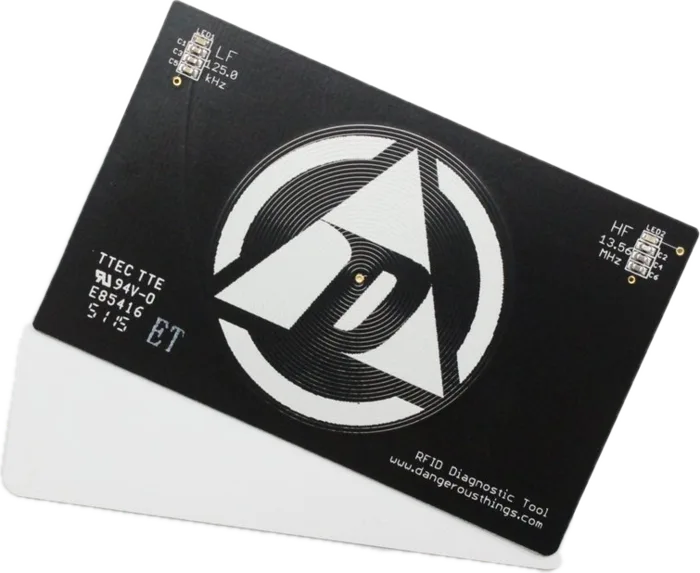
リーダーが125kHzと13.56MHzのどちらの磁界を出しているか調べるカード Wallet card that shows whether a reader emits 125 kHz, 13.56 MHz, or both.
本製品は
RFID Diagnostic Cardは、
すでに
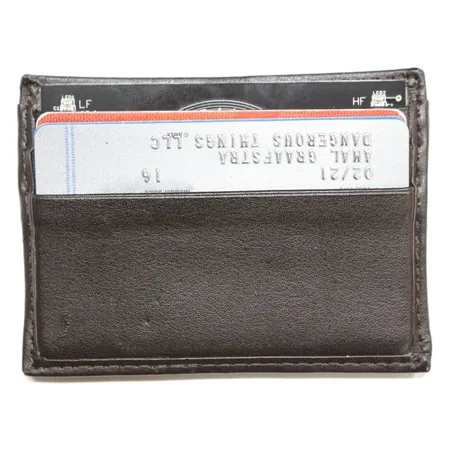
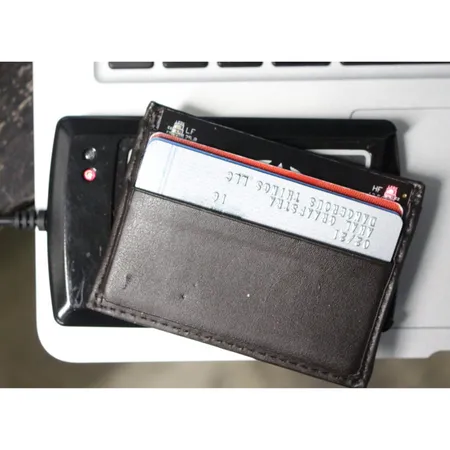
The RFID Diagnostic Card is a passive test card in ordinary card format. Hold it against a contactless reader and its indicators tell you which field that reader is producing: one window responds to 125 kHz, the other to 13.56 MHz, and a reader driving both will light both. The brightness of an indicator gives a rough sense of field strength, and the way it pulses shows the duty cycle, meaning how often the reader switches its field on rather than leaving it running.
It is a diagnostic tool for people who already work with RFID. It stores no data, carries no ID and cannot be programmed. What it does is answer the first question about an unfamiliar reader, which frequency is this, before anything else is tried. It fits in a wallet alongside ordinary cards.
- 対応周波数Frequencies
- 125 kHz / 13.56 MHz
- 形状Format
- カードサイズ (card format)
- 分かる
こと Indicates - 磁界の有無、強さの目安、デューティ比
- 電源Power
- パッシブ (passive, no battery)
 Dual Frequency Field Detector KeychainDual Frequency Field Detector Keychain
125kHzと
Dual Frequency Field Detector KeychainDual Frequency Field Detector Keychain
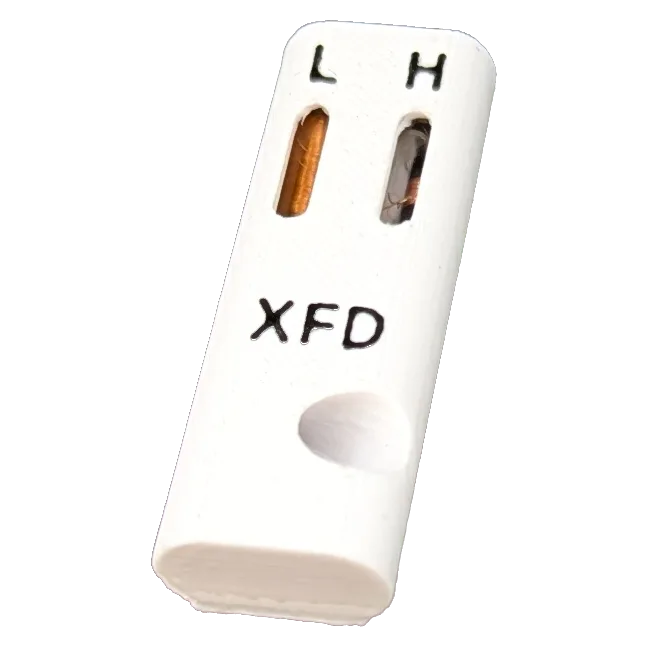
125kHzと13.56MHzの磁界の位置と向きを探すキーホルダー型の検出器 Keychain field detector for 125 kHz and 13.56 MHz, for finding a reader's read spot.
xFDが
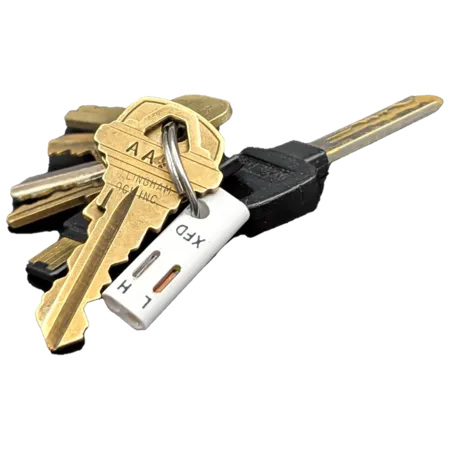
xFDは、
本来の
データは
The xFD is a field detector on a keyring. It carries a separate indicator for each frequency, marked L for 125 kHz and H for 13.56 MHz, so one wand tells you which frequency a reader runs at and, more usefully, exactly where its antenna windings lie.
Its real purpose is orientation. The antenna in an x-series device is a coil wound around a cylinder, and a coil of that shape couples with a reader only within a narrow band of positions and angles. Sweeping the detector across the face of a reader shows the spot, the rotation and the angle at which the device will read, which saves a great deal of guessing at a reader you have never used before.
It stores no data, carries no ID and draws all of its power from the reader's own field.
- 対応周波数Frequencies
- 125 kHz (L) / 13.56 MHz (H)
- 分かる
こと Shows - 位置、回転、角度 (position, rotation, orientation)
- 電源Power
- パッシブ (passive, no battery)
- 形状Form
- キーホルダー型 (keychain)
 Proxmark3 Easy (Iceman Firmware)Proxmark3 Easy (Iceman Firmware)
125kHzと
Proxmark3 Easy (Iceman Firmware)Proxmark3 Easy (Iceman Firmware)
125kHzと13.56MHz帯のRFID開発用ツール。Icemanファームウェア導入済み RFID research tool for 125 kHz and 13.56 MHz, with Iceman firmware preloaded.
本製品は
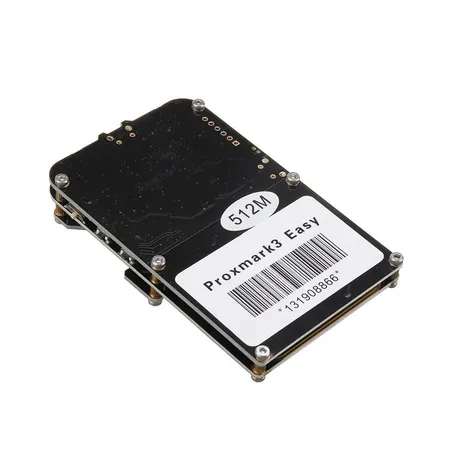
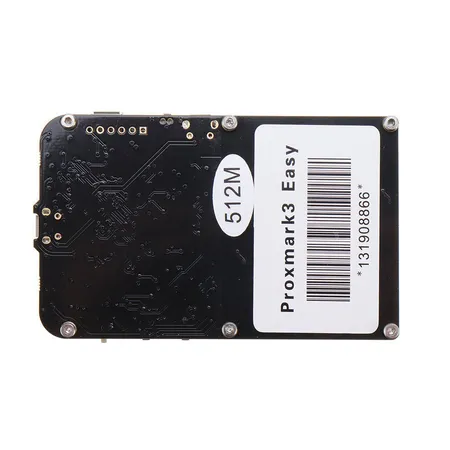
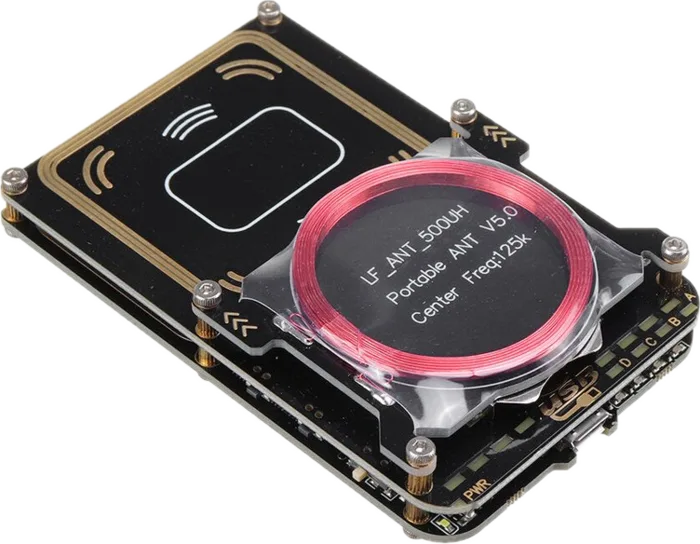
Proxmark3 Easyは、
本機は
標準の
The Proxmark3 Easy is a research and development tool for RFID at 125 kHz and 13.56 MHz. It reads, writes, records and replays what passes between a reader and a transponder, which is how people debug an access control system, identify an unknown credential, or work out why a particular reader will not see a particular device. It needs a host computer and is driven from a command line.
This unit ships with the Iceman bootloader and firmware already loaded, which is the community fork most people end up running anyway, and it carries 512 kB of memory. The manufacturer states the preloaded image is the 2020-09-24 release; firmware is updated from the project's own repository afterwards. A set of assorted test cards is included.
The antennas fitted to the Easy are tuned for cards and fobs rather than for the small cylindrical antennas used in implants, so coupling with an implant works but works poorly. The Booster Board, sold separately, replaces the HF midboard for exactly that reason.
- 対応周波数Frequencies
- 125 kHz / 13.56 MHz
- メモリMemory
- 512 kB
- ファームウェアFirmware
- Iceman (2020-09-24 release, preloaded)
- 動作環境Host
- USB接続のホストコンピュータとコマンドライン操作が必要
- 同梱品Included
- LFアンテナ、HFアンテナ、各種テストカード
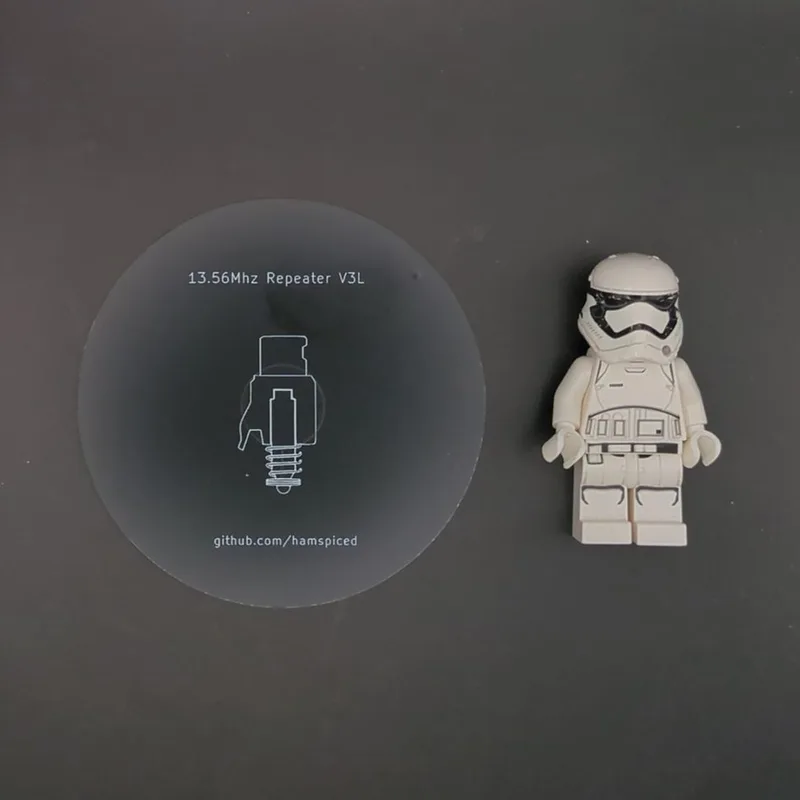 62mm Repeater Disc62mm Repeater Disc
リーダーの
62mm Repeater Disc62mm Repeater Disc
リーダーの13.56MHz磁界を再放射し結合を改善する直径62mmの硬質ディスク Rigid 62 mm disc that re-emits a reader's 13.56 MHz field to improve coupling.
リピーターディスクは
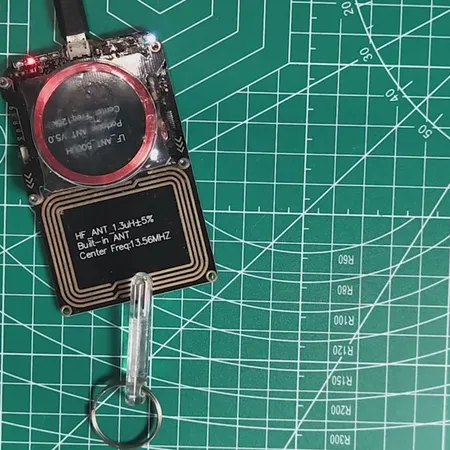
62mm Repeater Discは、
間
The 62 mm Repeater Disc is a rigid FR4 disc made by Midwest Gadgets that improves how well a 13.56 MHz reader couples with a small transponder antenna. It is entirely passive: no power, no data, nothing to configure. The reader's field induces a current in the disc, and the disc re-emits a field of its own, concentrated over its own area.
Where it sits is the part people get wrong. The disc should cover part of the reader's antenna rather than sit centered on it, which is what forces the lines of flux through the disc. A field detector makes finding that position quick. Once it is in place, present the transponder to the disc rather than to the reader's original antenna area.
- 直径Diameter
- 62 mm
- 周波数Frequency
- 13.56 MHz
- 素材Material
- FR4 (rigid PCB)
- 製造Maker
- Midwest Gadgets
- 電源Power
- パッシブ (passive, no battery)
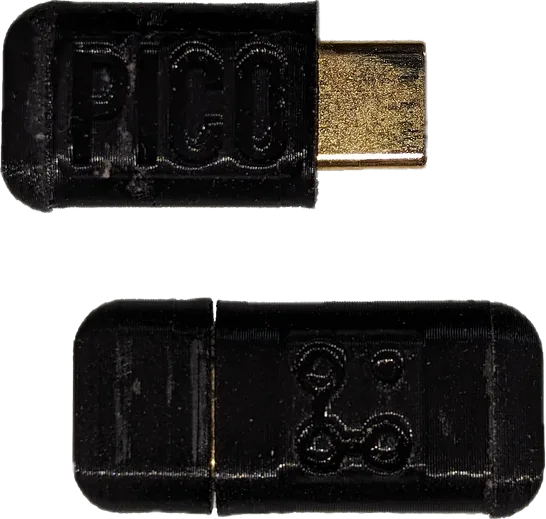 Lodestone PICOLodestone PICO
音を
Lodestone PICOLodestone PICO
音を磁界に変え、磁石インプラントで感じるためのUSB-Cドングル USB-C audio dongle that turns sound into a field an implanted magnet can feel.
本製品は
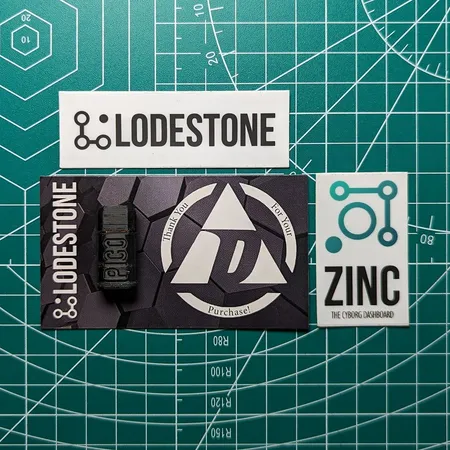
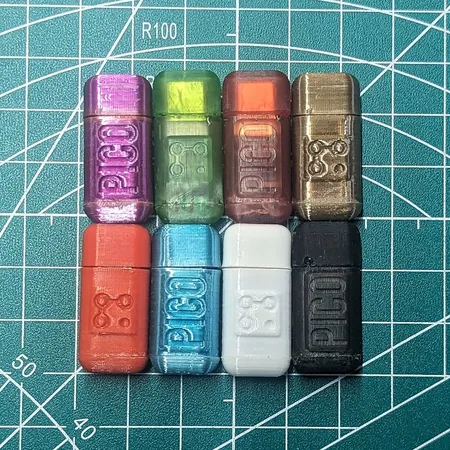
Lodestone PICOは、
研究者の
The Lodestone PICO is a USB-C dongle that presents itself to a computer or phone as an ordinary USB audio output. Instead of driving a speaker it drives a coil, turning whatever is playing into a changing magnetic field, which a person with an implanted magnet such as the Titan or the xG3 feels directly. Music, film audio and game sound all work, because the device sits in the normal audio path and needs nothing special from the source.
It was developed by the researcher Axel Fougues as a way of exploring what implanted magnets can do as a haptic sense. It is an experimental instrument rather than audio equipment. The color of the unit shipped is random.
- インターフェースInterface
- USB-C, USB Audio class
- 必要な
もの Requires - 磁石インプラント (Titan / xG3 など)
- 開発Developed by
- Axel Fougues
- 本体色Color
- ランダム (not selectable)
 KBR1 Keyboard ReaderKBR1 Keyboard Reader
読み取った
KBR1 Keyboard ReaderKBR1 Keyboard Reader
読み取ったIDをキーボードのように入力するUSBリーダー。HF版とLF版 USB reader that types a tag ID like a keyboard. HF or LF version, no drivers.
KBR1は、
KBR1は、
2種類が
IDを
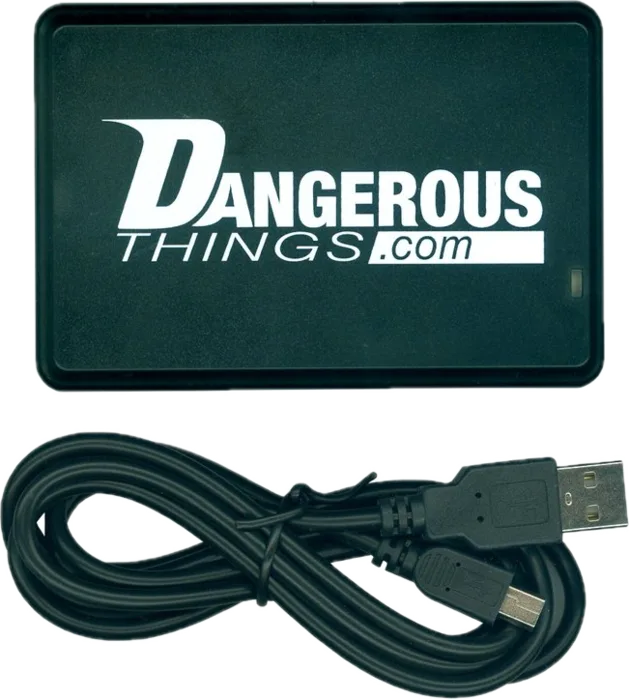
The KBR1 is a keyboard wedge reader. Plugged into a USB port it presents itself as an ordinary keyboard, so when it reads a transponder it types the ID out wherever the cursor happens to be: a text field, a spreadsheet, a terminal window. No driver is needed and nothing has to be installed.
Two versions are made and each reads one frequency only. The HF version reads ISO14443A at 13.56 MHz. The LF version reads EM41xx at 125 kHz. Choose the one that matches what you intend to read, because they are not interchangeable.
Because it simply types an ID as text, it is the shortest path between a transponder and software that has no idea RFID exists: a login script, a local database, an attendance sheet.
- 種類Versions
- HF (ISO14443A, 13.56 MHz) / LF (EM41xx, 125 kHz)
- インターフェースInterface
- USB HIDキーボードとして動作
- ドライバーDrivers
- 不要 (none required)
- 出力Output
- IDをテキストとして入力
 J3R452 JCOP 4.5 Smart CardJ3R452 JCOP 4.5 Smart Card
JCOP 4.5搭載の
J3R452 JCOP 4.5 Smart CardJ3R452 JCOP 4.5 Smart Card
JCOP 4.5搭載の開発用Java Card。flexSecureと同じアプレット入り Dual interface Java Card development card, JCOP 4.5, with the flexSecure applet set.
本製品は、
J3R452は、
搭載アプレットは
3つの
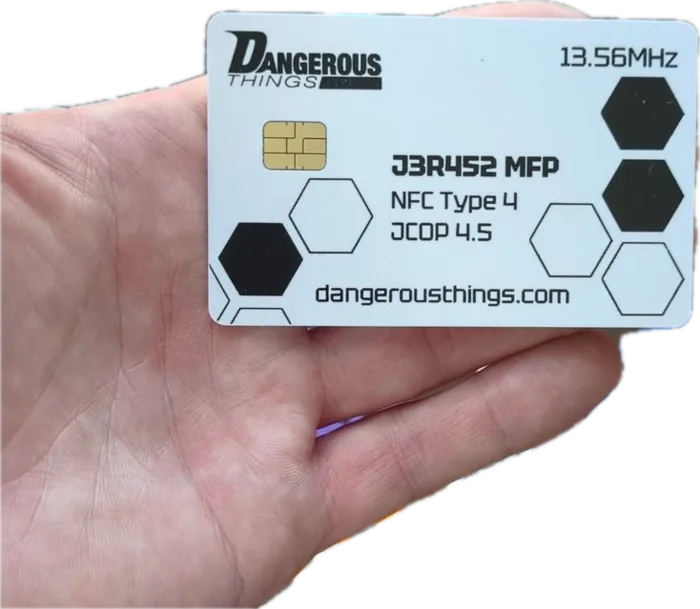
The J3R452 is a dual interface Java Card, contact and contactless, sold as a development and test card. It runs JCOP 4.5 with Java Card 3.0.5 and leaves roughly 30,400 bytes of EEPROM free for applets once the preloaded set is in place. The platform holds Common Criteria EAL 6+ along with other national certification schemes, and the card arrives with the factory default master key so that a developer can load applets immediately. It is configured with a 4 byte NUID.
It carries the same applets as the flexSecure: a free memory reporter, a FIDO2 style passkey applet with U2F fallback, an OTP authenticator, and an NFC sharing applet with a 32 kB NDEF container. That makes it the thing to develop and prove an applet on before anything is loaded onto an implant.
Three variants are offered. The first has no emulation. The second adds MIFARE Plus EV3C emulation for AES based access control, and is not personalised before shipping unless asked, since personalising it would mean sending the key with it. The third is DESFire EV3C, which includes the DESFire application and file system and can additionally present an application as MIFARE Classic 1k, so one card covers both modern DESFire readers and legacy ones. The DESFire variant ships configured.
- プラットフォームPlatform
- JCOP 4.5 / Java Card 3.0.5
- 利用可能EEPROMFree EEPROM
- 約30,400 bytes
- 認証Certification
- Common Criteria EAL 6+
- インターフェースInterface
- 接触 + 非接触 (dual interface)
- UIDUID
- 4 byte NUID
- 構成Variants
- None / MIFARE Plus EV3C / DESFire EV3C
- 搭載アプレットPreloaded applets
- Free Memory, FIDO2 (U2F fallback), OTP Authenticator, NFC Sharing (32 kB NDEF)
 Single Basic CardSingle Basic Card
お好きな
Single Basic CardSingle Basic Card
お好きなトランスポンダを1枚に。リーダーの対応を先に確かめるテストカード One test card in the transponder type of your choice, for checking a reader first.
Magic MIFARE Classic系の
お選びいただいた
手軽に
練習の
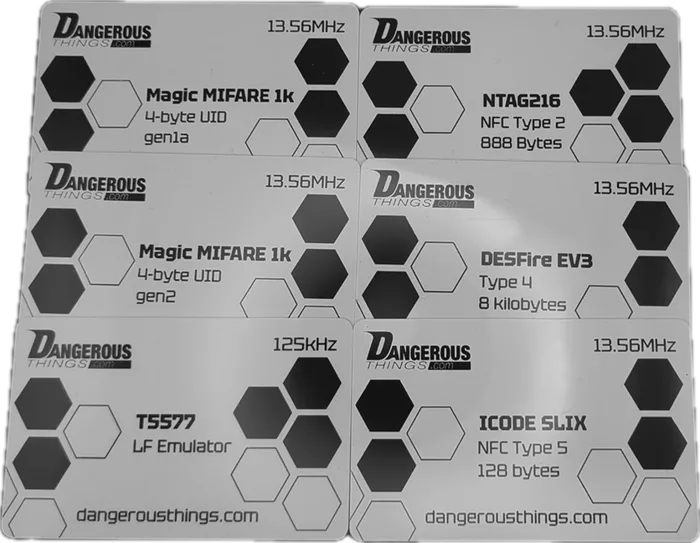
A single test card in standard card format, carrying the transponder you choose. The options are a T5577 at 125 kHz, a Magic MIFARE Classic 1k in gen1a, gen2 or gen3, an NTAG216, a DESFire EV3 or an ICODE SLIX, which are the same transponder families used in the implants.
It answers two questions cheaply. The first is compatibility: does this lock, this reader or this project actually work with this type of transponder, asked before anything is decided. The second is diagnosis: if a reader reads the card but not an implant, the problem is coupling and range rather than compatibility, and those have different fixes.
It is also where practice belongs. Cloning, programming and enrollment are all easier to learn on a card you can put down and pick up again.
- 形状Format
- カードサイズ (card format)
- T5577T5577
- 125 kHz LFエミュレーター。xEM, NExT (LF側), flexEM, dT5, xMagic (LF側)
- Magic MIFARE Classic 1k gen1aMagic MIFARE Classic 1k gen1a
- 13.56 MHz, UID書き換え可 (backdoor)。xM1, xMagic (HF側)
- Magic MIFARE Classic 1k gen2Magic MIFARE Classic 1k gen2
- 13.56 MHz, UID直接書き込み
- Magic MIFARE Classic 1k gen3Magic MIFARE Classic 1k gen3
- 13.56 MHz, UIDは一度だけ設定可
- NTAG216NTAG216
- 13.56 MHz NFC Type 2。xNT, NExT (HF側), dNExT, flexNT
- DESFire EV3DESFire EV3
- 13.56 MHz NFC Type 4。flexDFシリーズ
- ICODE SLIXICODE SLIX
- 13.56 MHz ISO15693。xSLX
 Proxmark3 Easy Booster BoardProxmark3 Easy Booster Board
Proxmark3 Easyの
Proxmark3 Easy Booster BoardProxmark3 Easy Booster Board
Proxmark3 EasyのHF基板を置き換え、インプラントとの結合を改善する基板 Replacement HF midboard for the Proxmark3 Easy, for better coupling with implants.
本製品は
Booster Boardは、
Proxmark3 Easyの
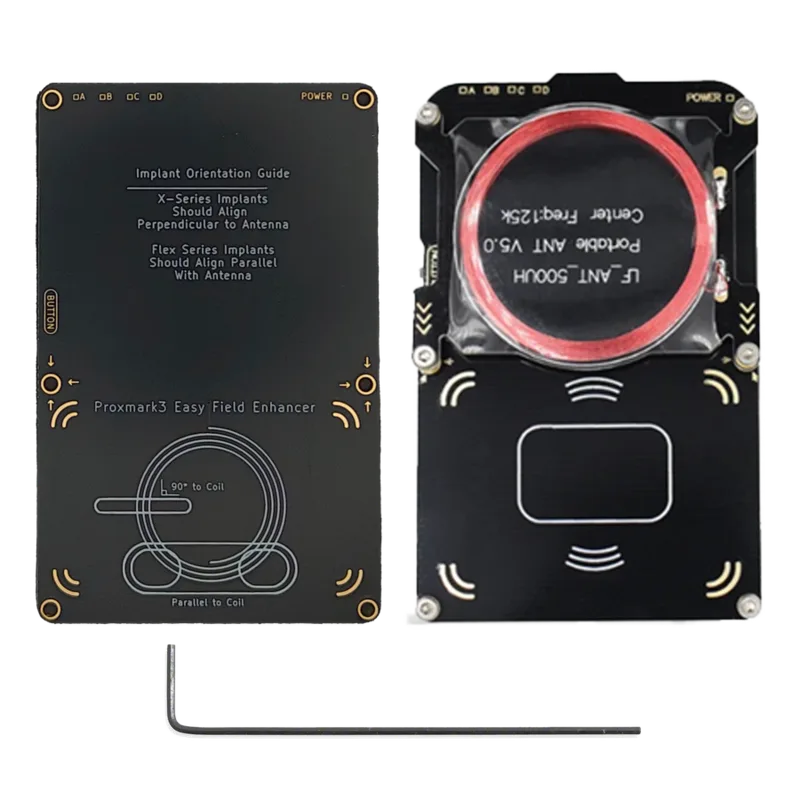
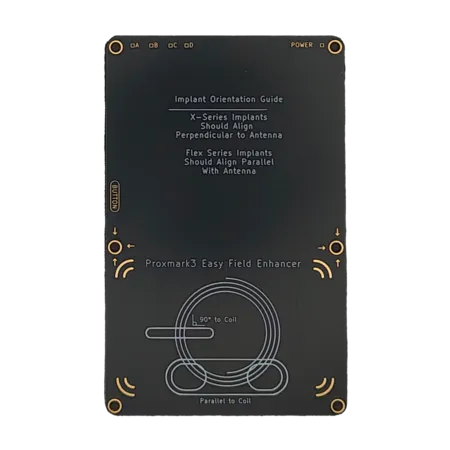
The Booster Board replaces the HF midboard of a Proxmark3 Easy with a better NFC antenna. The antennas the Easy ships with are designed around cards and fobs and couple poorly with the small cylindrical antenna of an implant. This board is the fix for that, and it makes a clear difference at 13.56 MHz. It is made by Midwest Gadgets, and the board itself is printed with a diagram showing how to align x-series and flex devices against it.
It does not fit every version of the Proxmark3 Easy. The maker publishes an STL file so the fit can be printed and checked before ordering.
- 周波数Frequency
- 13.56 MHz
- 適合Fits
- Proxmark3 Easy (一部のバージョンは非対応)
- 置き換え対象Replaces
- 標準のHFミッドボード
- 製造Maker
- Midwest Gadgets
 UG4 Test CardUG4 Test Card
Ultimate Magic gen4の
UG4 Test CardUG4 Test Card
Ultimate Magic gen4のエミュレーターカード。セクター0まで書き換え可能 Ultimate Magic gen4 emulator card, 13.56 MHz, with a fully writable sector 0.
Ultimate Magic gen4
本製品は、
UG4 Test Cardは、
flexUG4およびdUG4Tの
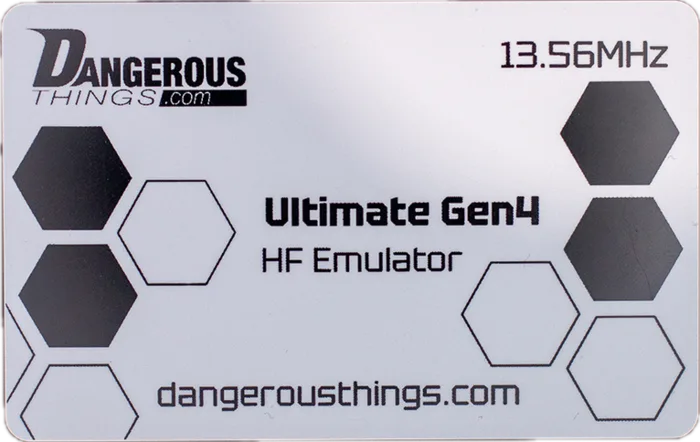
The UG4 Test Card carries an Ultimate Magic gen4 emulator at 13.56 MHz, version 06 A0. It is configurable rather than fixed: the UID can be set to 4, 7 or 10 bytes, the whole of sector 0 including the manufacturer block is writable, and the card can be made to present itself as a variety of ISO14443 transponders.
It is the card equivalent of the flexUG4 and the dUG4T, which makes it the right thing to test a reader with, and the right thing to practice configuration on, before configuring an implant.
- 周波数Frequency
- 13.56 MHz
- ICIC
- Ultimate Magic gen4 (version 06 A0)
- UIDUID
- 4 / 7 / 10 byte, 書き換え可
- セクター0Sector 0
- 全体が書き換え可 (writable)
- 対応インプラントMatches
- flexUG4, dUG4T
 xEM Access ControllerxEM Access Controller
125kHz帯EM系IDに
xEM Access ControllerxEM Access Controller
125kHz帯EM系IDに対応する12V DCの入退室制御基板。リレー内蔵 12 V DC access control board with an onboard relay, for 125 kHz EM style IDs.
本製品は
xEM Access Controllerは、
読み取れるのは
電源が
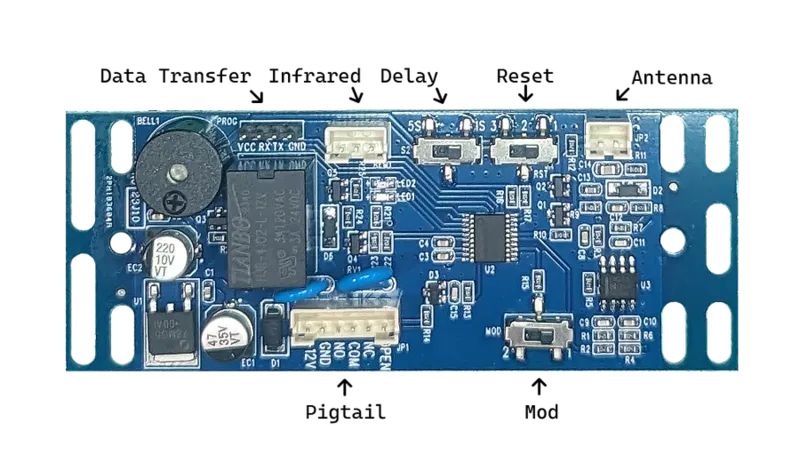
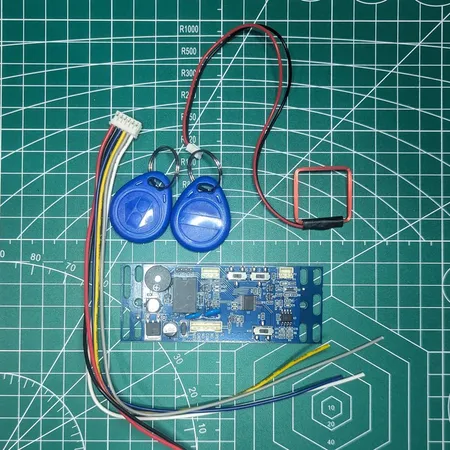
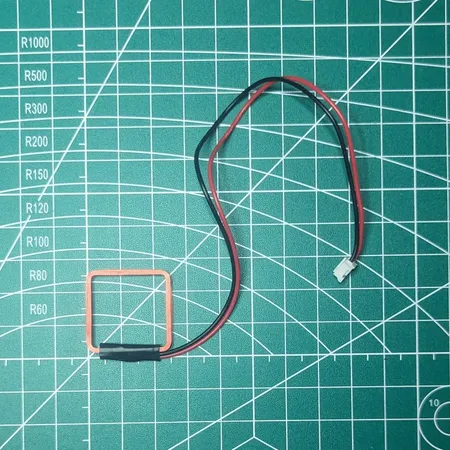
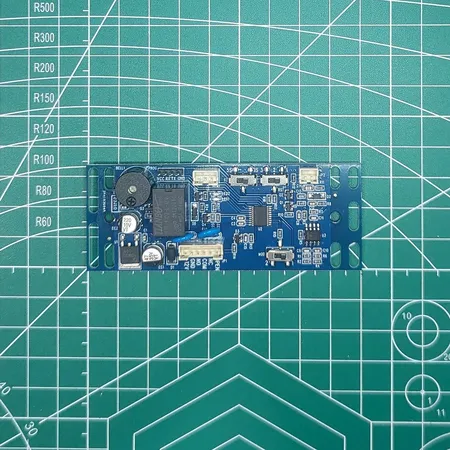
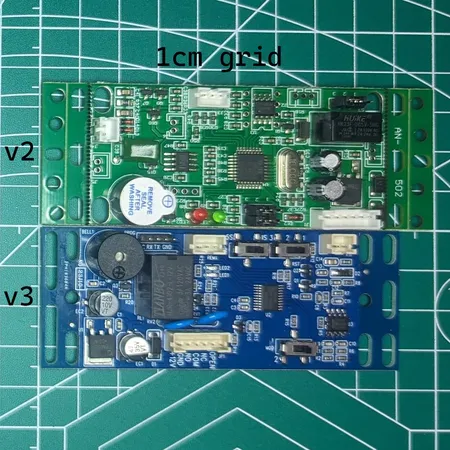
The xEM Access Controller is a small 12 V DC access control board for projects. The relay is on the board, so nothing external is needed to switch a lock, a gate or a vehicle circuit, and there is a buzzer and a row of screw terminals for the wiring. The kit includes the controller board, a wiring harness, an antenna coil and two 125 kHz keyfobs.
It reads 125 kHz EM41xx style IDs, so it works with the xEM, and with the NExT and NExT v2 while their low frequency side is in EM mode. Up to 150 IDs can be stored. Enrollment happens on the board itself: an onboard switch sets a master tag, and no computer is involved at any point.
It runs on 12 V DC, which is why it turns up in vehicle projects as often as in doors.
- 電源Supply
- 12 V DC
- 読み取り対象Reads
- 125 kHz EM41xx系ID
- 対応インプラントWorks with
- xEM, NExT / NExT v2 (低周波側をEMモードに設定した場合)
- 登録件数Capacity
- 最大150件
- リレーRelay
- 基板上に内蔵 (onboard)
- 同梱品Included
- 制御基板、配線ハーネス、アンテナコイル、キーフォブ2個
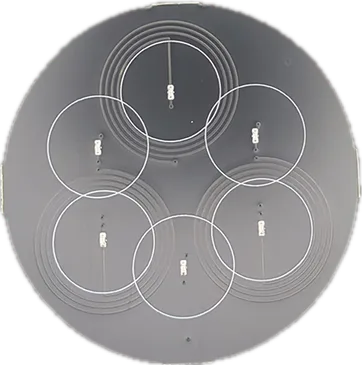 Field Visualizer RingField Visualizer Ring
13.56MHzリーダーの
Field Visualizer RingField Visualizer Ring
13.56MHzリーダーの磁界の広がりを一度に見渡せるパッシブ工具 Passive tool that shows the shape of a 13.56 MHz reader's field over a wide area.
磁界の
Field Visualizer Ringは、
同種の
The Field Visualizer Ring is a passive tool from Midwest Gadgets for seeing the shape of an NFC reader's field quickly, across a wider area than a single point detector covers. Nothing is powered and nothing is configured: it responds to the field and shows you where it is.
It sits between the other two tools in the kit. The xFD keychain detector is precise and dual frequency and will show you exactly where a reader's windings run, but examining a whole reader with it is slow. The RFID Diagnostic Card answers the frequency question in one gesture and shows little about where the field actually is. The Visualizer Ring is the one to reach for if you work across many different readers, or find yourself testing unfamiliar readers out in the world, and want the answer quickly.
- 周波数Frequency
- 13.56 MHz
- 分かる
こと Shows - 磁界の広がりと強い位置
- 電源Power
- パッシブ (passive, no battery)
- 製造Maker
- Midwest Gadgets
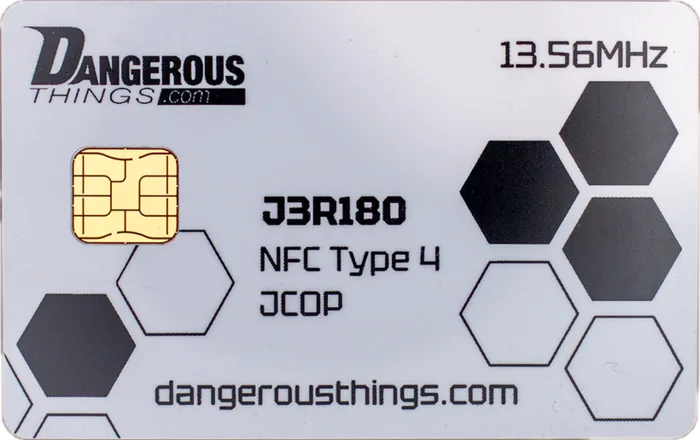 J3R180 JCOP 4 Smart CardJ3R180 JCOP 4 Smart Card
flexSecure用の
J3R180 JCOP 4 Smart CardJ3R180 JCOP 4 Smart Card
flexSecure用のテスト兼バックアップ。JCOP 4搭載のJava Card Dual interface JCOP 4 Java Card, a test card and backup for the flexSecure.
本製品は、
J3R180は、
flexSecureおよびVivoKey Apexと
The J3R180 is a dual interface Java Card sold as a test card and a backup for the flexSecure. It runs the JCOP 4 operating system for Java Card 3.0.5 applets, with 167,736 bytes of EEPROM available, and the platform carries Common Criteria EAL 6+ along with other national certification schemes. It arrives with the factory default master key, so applets can be loaded immediately.
Because it is the same secure element family used in the flexSecure and the VivoKey Apex, an applet developed and proved on this card behaves the same way on the implant. Keeping one also means a working copy of your applet set exists somewhere other than in your hand.
- プラットフォームPlatform
- JCOP 4 / Java Card 3.0.5
- EEPROMEEPROM
- 167,736 bytes
- 認証Certification
- Common Criteria EAL 6+
- インターフェースInterface
- 接触 + 非接触 (dual interface)
- 対応製品Matches
- flexSecure, VivoKey Apex
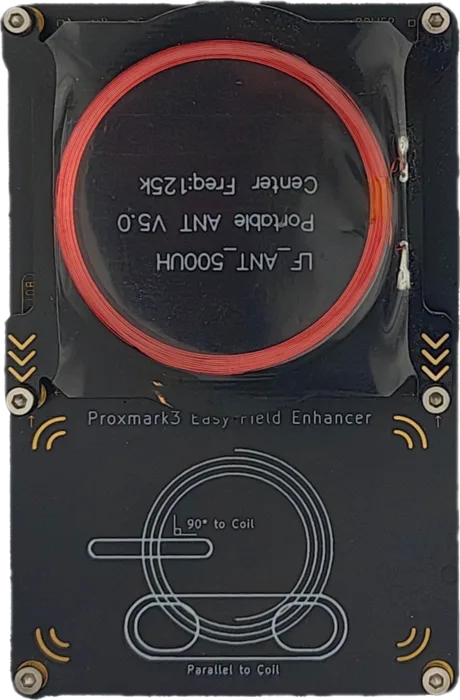 Proxmark3 Easy with Booster BoardProxmark3 Easy with Booster Board
Booster Boardを
Proxmark3 Easy with Booster BoardProxmark3 Easy with Booster Board
Booster Boardを組み付けた状態のProxmark3 Easy Proxmark3 Easy supplied with the Booster Board already fitted in place of the midboard.
本製品は
Proxmark3 Easyと
組み合わせで
This is the Proxmark3 Easy and the Booster Board sold together, with the board already fitted in place of the standard HF midboard. The tool itself is the same one described under Proxmark3 Easy: a 125 kHz and 13.56 MHz research and development device with the Iceman bootloader and firmware preloaded, 512 kB of memory, driven from a host computer over USB.
The reason to take the pair is coupling. The antennas the Easy ships with are tuned for cards and fobs and read implants poorly, and the Booster Board is the part that corrects that at 13.56 MHz. Buying them together also avoids the fitment question, since the board that arrives is one that fits the unit it arrives on.
- 構成Contents
- Proxmark3 Easy (Iceman firmware) + Booster Board (取付済み)
- 対応周波数Frequencies
- 125 kHz / 13.56 MHz
- メモリMemory
- 512 kB
- 動作環境Host
- USB接続のホストコンピュータとコマンドライン操作が必要
 NFC MR CardNFC MR Card
x-series用の
NFC MR CardNFC MR Card
x-series用のMRカードに、読み取り専用のNFCを追加したもの The printed MR card for the x-series, with a read only NFC record added.
NXP NTAG213
本カードは
MRカードは、
NTAG213を
An MR card is the card you hand to medical staff before an imaging examination, so that the facility knows what you have. This is an MR card with a read only NFC tag added, available by order through VivoKey Japan.
It is an NTAG213 carrying a preset NDEF record that points to the manufacturer's own MR information page, alongside the same printed graphics and text as the manufacturer's own card. The record is deliberately read only, since the card exists to be handed to someone else and its contents should not be alterable by whoever is holding it. The version currently offered covers the Dangerous Things x-series.
- ICIC
- NXP NTAG213
- 周波数Frequency
- 13.56 MHz
- NDEFレコードNDEF record
- 読み取り専用 (read only)
- 対象Covers
- Dangerous Things x-series
- 印刷Printing
- メーカーの印刷版と同じ図版・文面
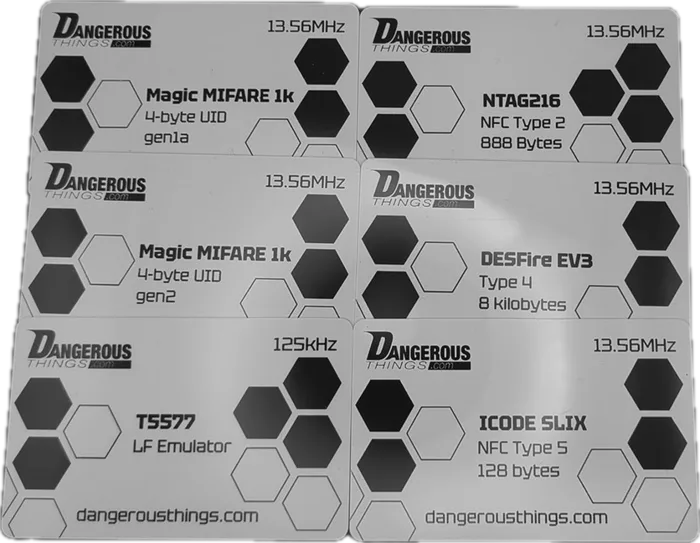 Card PackCard Pack
主要な
Card PackCard Pack
主要なトランスポンダを1枚ずつ揃えた6枚組のテストカード Six cards, one for each transponder family, for testing a reader without an implant.
Magic MIFARE Classicの
Card Packは、
先に
The Card Pack is a set of six cards, one for each of the transponder families used in the implants, so that a reader, a lock or a project can be tested without buying or using an implant at all. The pack holds a T5577 low frequency emulator, a Magic MIFARE Classic 1k gen1a, a Magic MIFARE Classic 1k gen2, an NTAG216 with 888 bytes, a DESFire EV3 with 8 kB and an ICODE SLIX.
Testing on cards first settles the compatibility question before anything is decided, and separates it cleanly from the range question afterwards: a reader that reads the card but not an implant has a coupling problem, not a compatibility one.
- 内容Contents
- 6枚組 (6 cards)
- 低周波側LF
- T5577 (125 kHz emulator)
- 高周波側HF
- Magic MIFARE Classic 1k gen1a / gen2, NTAG216 (888 bytes), DESFire EV3 (8 kB), ICODE SLIX
- 形状Format
- カードサイズ (card format)
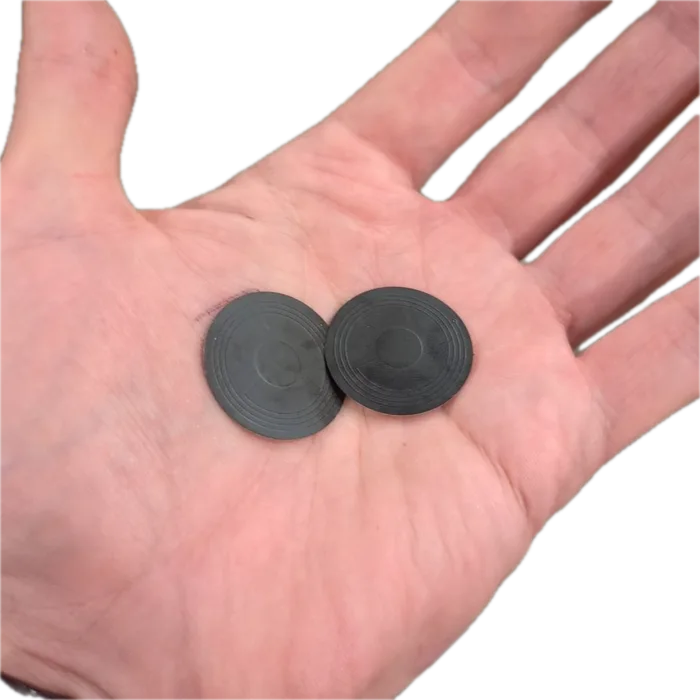 Repeater Sticker PackRepeater Sticker Pack
13.56MHzリーダーの
Repeater Sticker PackRepeater Sticker Pack
13.56MHzリーダーの磁界を集中させる、薄い貼付式ディスク2枚組 Two thin adhesive discs that concentrate a 13.56 MHz reader's field.
本製品は
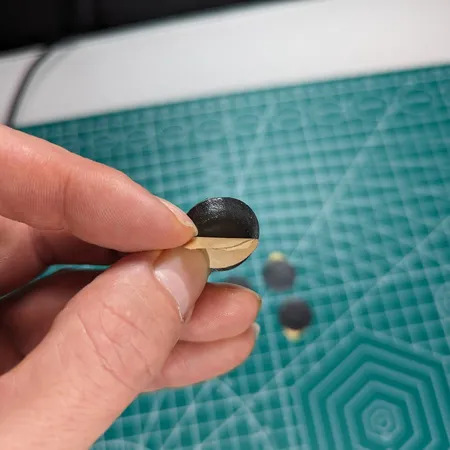
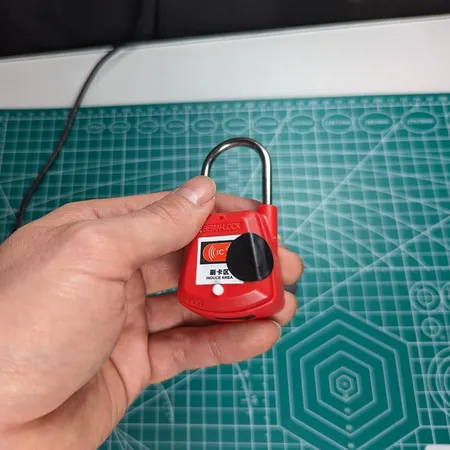
Repeater Sticker Packは、
貼る
The Repeater Sticker Pack is two Field Concentrator Stickers from Midwest Gadgets. Each is a thin adhesive disc that improves how well a 13.56 MHz reader couples with a small transponder antenna, and each is entirely passive: no power, no data, nothing to configure. The reader's field induces a current in the sticker, and the sticker re-emits a concentrated field of its own over the area where it sits.
Put it over part of the reader's antenna rather than centered on it, which is what forces the flux through the sticker. Clean the surface with the alcohol pad supplied before applying, because the bond is meant to last. Once applied they are nearly invisible against most surfaces.
- 枚数Quantity
- 2枚 (2 stickers)
- 周波数Frequency
- 13.56 MHz
- 電源Power
- パッシブ (passive, no battery)
- 同梱品Included
- アルコールパッド
- 製造Maker
- Midwest Gadgets
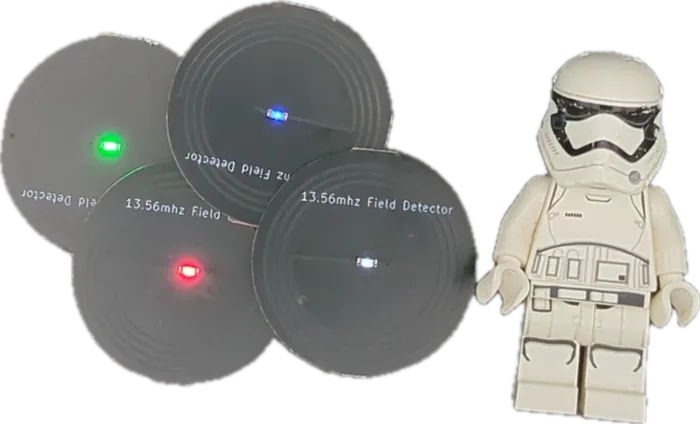 27mm Field Detector27mm Field Detector
リーダーの
27mm Field Detector27mm Field Detector
リーダーの磁界で光る小型のパッシブ円盤。リピーターの位置決め用 Small passive disc that lights in a reader's field, for placing repeater stickers.
磁界の
Midwest Gadgets製、
色は
A 27 mm passive detector disc from Midwest Gadgets. It lights in a reader's field and does nothing else, which is precisely what is wanted when the question is where to put a repeater sticker or a rigid repeater disc. Move it across the face of the reader, and the place where it responds best is the place the repeater belongs.
Four colors are offered: red, green, blue and white. The color is cosmetic and does not change how it behaves.
- 直径Diameter
- 27 mm
- 色Colors
- レッド / グリーン / ブルー / ホワイト
- 電源Power
- パッシブ (passive, no battery)
- 用途Use
- リピーターディスク・ステッカーの位置決め
- 製造Maker
- Midwest Gadgets
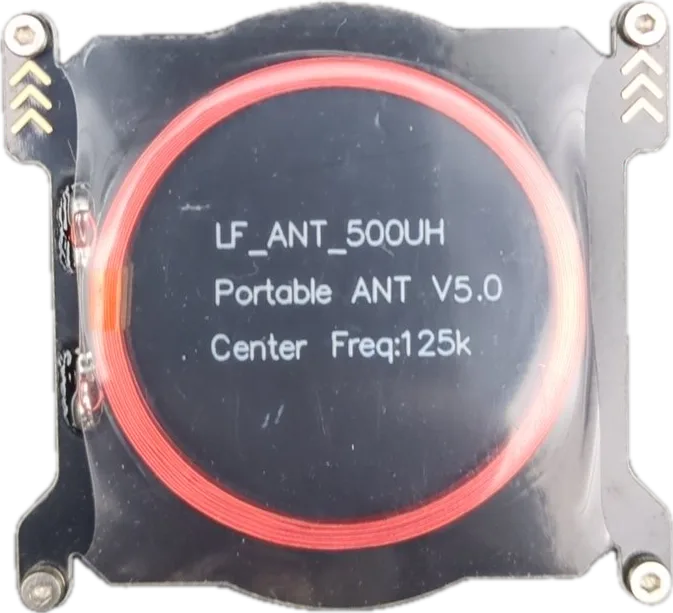 Proxmark LF AntennaProxmark LF Antenna
Proxmark3 Easy用の
Proxmark LF AntennaProxmark LF Antenna
Proxmark3 Easy用の125kHz帯アンテナ。ネジとスペーサー付き Replacement 125 kHz antenna for the Proxmark3 Easy, with screws and standoffs.
コイルと
Proxmark3 Easy用の
アンテナ自体には
A replacement 125 kHz low frequency antenna for the Proxmark3 Easy, supplied with the screws and standoffs needed to mount it. It is offered because this is the part most often lost or damaged on a well used unit.
It carries no electronics of its own. It is simply the coil the Proxmark3 drives when it works at 125 kHz.
- 周波数Frequency
- 125 kHz
- 対応機器For
- Proxmark3 Easy
- 同梱品Included
- ネジ、スペーサー (screws and standoffs)
 VivoKey Dev KitVivoKey Dev Kit
VivoKeyプラットフォームの
VivoKey Dev KitVivoKey Dev Kit
VivoKeyプラットフォームのAPI開発用デモカード2枚組 Two demo cards for developing against the VivoKey platform API.
本製品は
VivoKey Dev Kitは、
APIの
The VivoKey Dev Kit is two demo cards for developers building against the VivoKey platform. The manufacturer describes them as using the ISO15693 protocol, which iOS 14 and later and Android 8 and later both support, so a phone app can be built and tested against the cards without an implant being involved at any stage.
API documentation, mobile development libraries and API key management are handled through VivoKey's own developer portal.
- 内容Contents
- デモカード2枚 (2 demo cards)
- プロトコルProtocol
- ISO15693 (製造元の記載による)
- 対応OSMobile support
- iOS 14以降 / Android 8以降
- 用途For
- VivoKeyプラットフォームAPIの開発
身に
インプラントと
Aftermarket motogadget mo.lock keyAftermarket motogadget mo.lock key
motogadget mo.lock(NFC版)向けに設定されたNTAG213のキー NTAG213 key configured for the NFC version of the motogadget mo.lock.
NXP NTAG213
本製品への
motogadget社の
mo.lock自体に
本製品の
This is an aftermarket key for motogadget's mo.lock, the NFC version rather than the older low frequency one. It is an NTAG213, the same transponder motogadget itself uses, configured so that the lock accepts it.
The mo.lock is worth knowing about on its own terms: simple to fit, efficient with power, and reasonably secure for its price and its technology. While it is authenticated it outputs 12 V DC, which is what makes it useful as a keyless ignition on a motorcycle. Dangerous Things offers the same configuration as a factory option on the xNT, NExT, NExT v2 and xSIID.
The memory contents of this key must not be altered.
- ICIC
- NXP NTAG213
- 周波数Frequency
- 13.56 MHz
- 対応機器For
- motogadget mo.lock (NFC版のみ)
- メモリMemory
- 書き換え不可 (must not be altered)
 FauxFOBFauxFOB
書き換え可能な
FauxFOBFauxFOB
書き換え可能なトランスポンダ4基を収めたキーフォブ。押した1基だけが応答 Four programmable transponders in a keyfob, each connected only while its button is held.
FauxFOBに
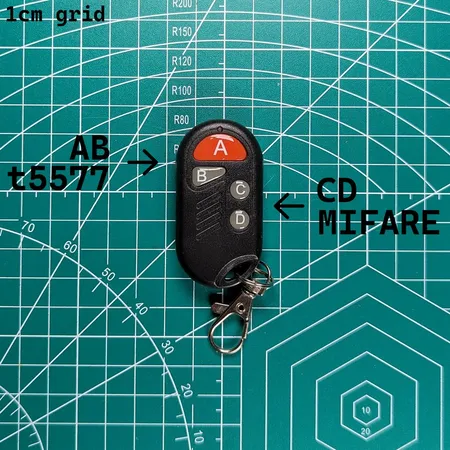
FauxFOBは、
アンテナに
Magic MIFARE側は
The FauxFOB looks like an ordinary car remote and holds four reprogrammable transponders: two T5577 at 125 kHz on buttons A and B, and two Magic MIFARE Classic 1k at 13.56 MHz on buttons C and D. Four credentials live in one object on a keyring.
Only the transponder whose button is held is connected to its antenna, so nothing responds unless you choose it. That is what makes keeping several at once practical: a reader sees one at a time and the others are invisible to it. It also means the fob is inert while it sits in a pocket.
The Magic MIFARE side is available in gen1a or gen2, chosen at order.
- 搭載トランスポンダTransponders
- T5577 x2 (125 kHz) + Magic MIFARE Classic 1k x2 (13.56 MHz)
- ボタンButtons
- A, B = T5577 / C, D = Magic MIFARE
- Magic MIFAREの
世代 Magic version - gen1a または gen2 (選択)
- 接続Connection
- ボタンを押している間のみ
 Blue BambinoBlue Bambino
書き換え可能な
Blue BambinoBlue Bambino
書き換え可能なトランスポンダ6基を収めたキーホルダー型タグ Six programmable transponders in a keychain tag, one connected per button press.
Blue Bambinoに
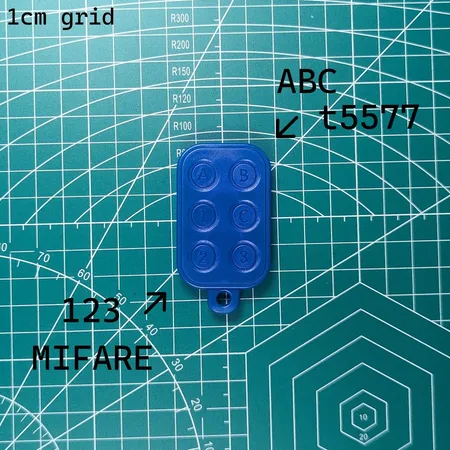
Blue Bambinoは、
FauxFOBと
Magic MIFARE側は
The Blue Bambino is a small keychain tag holding six reprogrammable transponders: three T5577 at 125 kHz on buttons A, B and C, and three Magic MIFARE Classic 1k at 13.56 MHz on buttons 1, 2 and 3.
As with the FauxFOB, a transponder is connected to its antenna only while its button is held, so a reader sees one at a time and the tag is inert otherwise. Six credentials in one unobtrusive object is the whole idea.
The Magic MIFARE side is available in gen1a or gen2, chosen at order.
- 搭載トランスポンダTransponders
- T5577 x3 (125 kHz) + Magic MIFARE Classic 1k x3 (13.56 MHz)
- ボタンButtons
- A, B, C = T5577 / 1, 2, 3 = Magic MIFARE
- Magic MIFAREの
世代 Magic version - gen1a または gen2 (選択)
- 接続Connection
- ボタンを押している間のみ
 Magic Ring (Magic MIFARE 1k + T5577)Magic Ring (Magic MIFARE 1k + T5577)
13.56MHzと
Magic Ring (Magic MIFARE 1k + T5577)Magic Ring (Magic MIFARE 1k + T5577)
13.56MHzと125kHzの書き換え可能なトランスポンダを収めた黒セラミックの指輪 Black ceramic ring holding a rewritable 13.56 MHz and a rewritable 125 kHz transponder.
リングサイズ 6〜13Ring size 6 to 13
セラミック製の
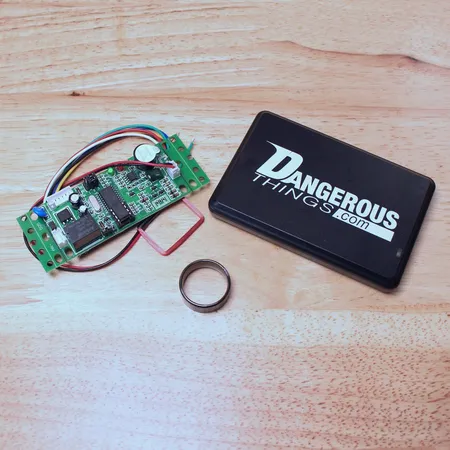
Magic Ringは、
リングには
サイズは
The Magic Ring is a black ceramic ring with a simple chamfered edge, holding two fully programmable transponders. One is a Magic MIFARE Classic 1k gen2 at 13.56 MHz, whose 4 byte ID can be rewritten and used with legacy ISO14443A systems. The other is a T5577 at 125 kHz, which a Proxmark3 can program to emulate a wide range of common work badges, keyfobs and access cards.
Two small marker dots on the band show where each antenna sits, which is the part of the ring to present to a reader. It is a wearable rather than an implant, so it comes off, and it can be left at home or set aside for a day.
Sizes 6 to 13 are offered.
- 素材Material
- セラミック、ブラック (ceramic)
- 高周波側HF transponder
- Magic MIFARE Classic 1k gen2 (13.56 MHz, 4 byte ID書き換え可)
- 低周波側LF transponder
- T5577 (125 kHz)
- リングサイズRing sizes
- 6 - 13
- 種別Type
- 身に着ける製品 (wearable, not an implant)
 Magic Ring v2 (Magic MIFARE 1k + T5577)Magic Ring v2 (Magic MIFARE 1k + T5577)
Magic MIFAREを
Magic Ring v2 (Magic MIFARE 1k + T5577)Magic Ring v2 (Magic MIFARE 1k + T5577)
Magic MIFAREをgen1aにしたMagic Ring。サイズは7から14 The Magic Ring with a gen1a Magic MIFARE transponder, in sizes 7 to 14.
リングサイズ 7〜14Ring size 7 to 14
セラミック製の
Magic Ring v2は、
マットブラックの
The Magic Ring v2 is the same black ceramic ring with a chamfered edge, holding two fully programmable transponders. The difference from the first version is the high frequency side: this one carries a Magic MIFARE Classic 1k gen1a at 13.56 MHz, whose 4 byte ID can be rewritten for use with legacy ISO14443A systems. The low frequency side is the same T5577 at 125 kHz, which a Proxmark3 can program to emulate common work badges, keyfobs and access cards.
It ships in a matte black presentation box. Sizes 7 to 14 are offered.
- 素材Material
- セラミック、ブラック (ceramic)
- 高周波側HF transponder
- Magic MIFARE Classic 1k gen1a (13.56 MHz, 4 byte ID書き換え可)
- 低周波側LF transponder
- T5577 (125 kHz)
- リングサイズRing sizes
- 7 - 14
- パッケージPackaging
- 化粧箱入り (presentation box)